The Ringing World’s June learner’s column featured Kennington, one of the core doubles variations and a good way of practising ringing Bob Doubles by where you pass the treble. By kind permission the whole article is shared here.
We have said several times: “To ring a doubles variation, learn the plain course and the call by where you pass the treble. If you understand place bells, be warned: the place you strike in at the lead-end is not necessarily the place bell you become, so it is best to ignore place bells when the nonstandard calls start.”
Kennington Doubles is a simple and very popular variation, and it’s a good first step into ringing in this way. So what do we mean when we say ‘ringing by where you pass the treble’?
Bob Doubles by the treble

Ringing ‘by the treble’ is a phrase that can be used in a general way to mean many things, but we can boil it down to a specific approach in the case of Plain Bob Doubles.
The first concept to understand is that the pieces of work in Bob Doubles that aren’t plain hunting all happen when the treble is leading.
Then look at the blue line (the path of the 2) in the plain course diagram. In the red highlighted patch, bell 2 passes (i.e. swaps with) four bells on its way out from lead to the back. These bells are in the order 4, then 5, then 3, then the treble (red line). So we say that the 2 meets the treble fourth, or that it passes it in 4-5.
Because all the pieces of work in Bob Doubles happen when the treble is leading, the moment at which you pass the treble when you’re hunting up and it’s hunting down are like timebombs: the fuse has now been lit, which will go off when the treble gets to the front. That’s when you have to do a piece of work.
So if you meet the treble as your fourth bell, in 4-5, you can be sure that the next piece of work you have to do is dodge 3-4 down.
In the yellow highlighted patch, bell 2 meets bells from the front in the order 4, 5, then 1: it passes the treble third, in 3-4, and that’s the cue to do long fifths next.
All these cues and pieces of work are laid out in the table here.
Pass At a plain lead
4-5  3-4 dodge down
3-4  long fifths
2-3  3-4 dodge up
1-2  make seconds
You should notice the correlation between the order and the circle of work for the Plain Bob plain course.
Try ringing some Plain Bob Doubles and noticing when you pass the treble and what piece of work you do next. Eventually you can use this method if you get lost: just carry on plain hunting until you meet the treble.
Some people use this approach as their primary way of ringing Bob Doubles. Beware, this does have a disadvantage: if the treble goes wrong, you’ll likely go wrong too. And if the reason you are ringing Bob Doubles is to help someone practise plain hunting on the treble, you will be an unreliable inside ringer. It’s best to always know what you should be doing independently, but to use signals like this to reinforce yourself.
Back to Kennington
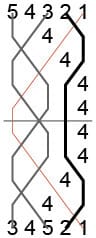
To ring the variation Kennington, you ring Plain Bob Doubles until a bob is called, and then do the work of a Reverse Canterbury Bob (shown right). After you’ve done the work for the bob, just plain hunt until you pass the treble when hunting up, and remember which Plain Bob work that tells you to do next.
A Reverse Canterbury Bob, called at the end of the first lead.