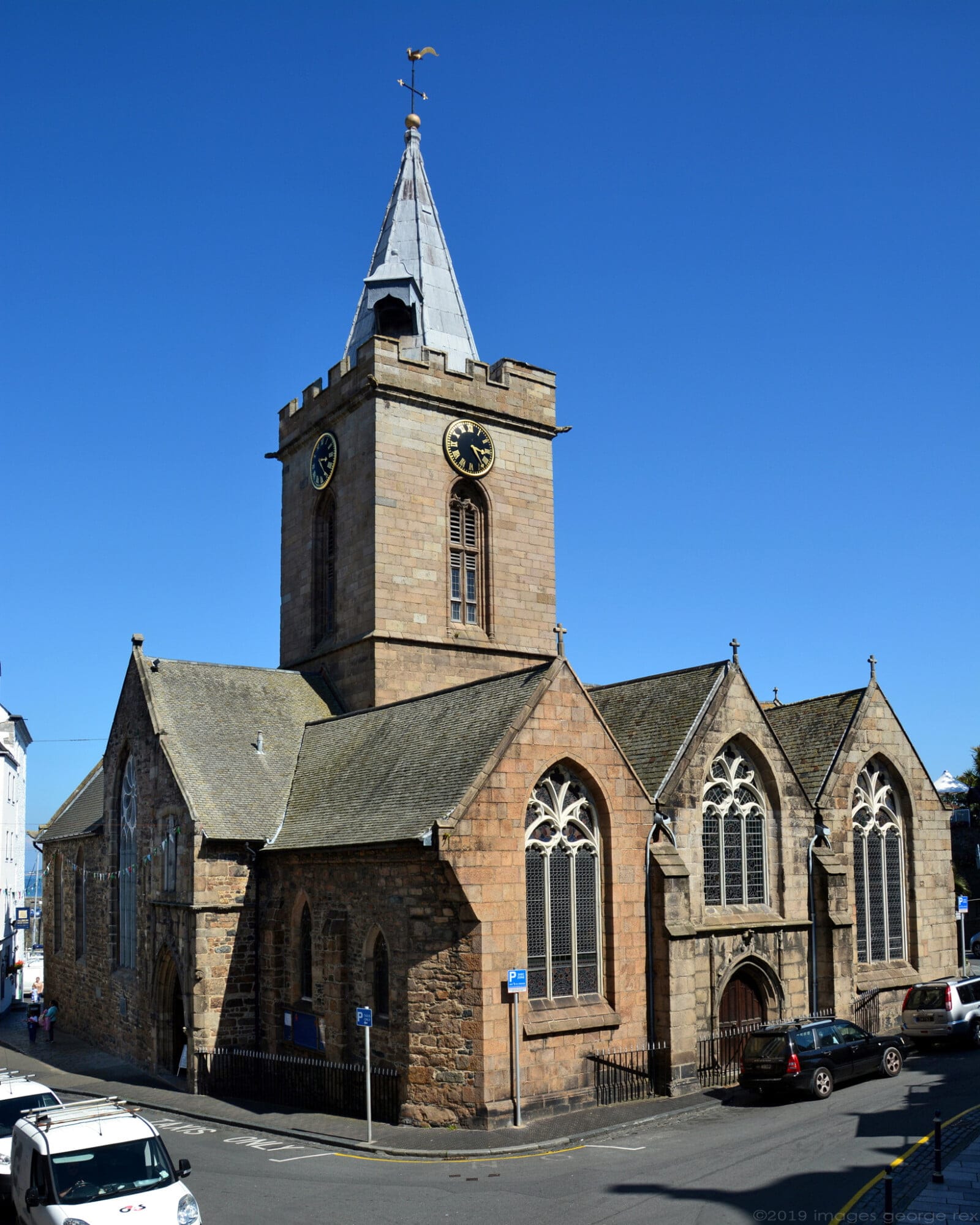
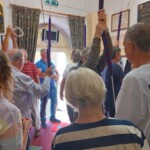
For September’s tower, we leave the mainland and travel nearly 200 miles south to Guernsey, the second largest of the Channel Islands. Very recently all of the Church of England churches on the Channel Islands, and consequently the rings of bells within them, transferred to the Salisbury Diocese. The Guild has therefore had an injection of new towers and new ringers, comprising the nine towers on the islands of Alderney, Guernsey, and Jersey. This month’s tower in focus will be the Town Church at St Peter Port in Guernsey. Will the unique position of the Channel Islands, a British territory close to the French mainland, have affected the development of change ringing there? Read on to find out!
One of the earliest mentions of a church in St Peter Port was in a document of 1048, where William, Duke of Normandy, assigns the “ecclesia Sancti Petri du Portu” to the Abbey of Marmoutier, under whose patronage it remained until the Dissolution of the Monasteries almost 500 years later. The present church, the largest in the Channel Islands, is a handsome and imposing structure, mostly dating from a Gothic rebuilding in the 15th century as a result of a fire. It does incorporate some earlier Norman architecture in the nave, but owing to its position as an English island near the French coastline, the town and the church were frequently attacked (including one siege by the Spanish!), which often meant repairs and alterations. The town’s allegiance to Cromwell in the English Civil War led to further damage. Few towers in the Salisbury Guild can claim to have been attacked in the past by the English, the French, and the Spanish!
The sizeable central tower, which sits on large 14th-century stone piers, was completed between 1466 and 1473. Its height was augmented in 1721 with the construction of a shallow, octagonal spire, made of timber and covered in lead. The tower was presumably provided with at least one bell from the outset, unfortunately, records do not survive with any details of the original bells. However, the island certainly had bells at that time – one bell in St Phillipe’s Church in Torteval, located in the southwestern tip of Guernsey, still has one bell today dated 1432.
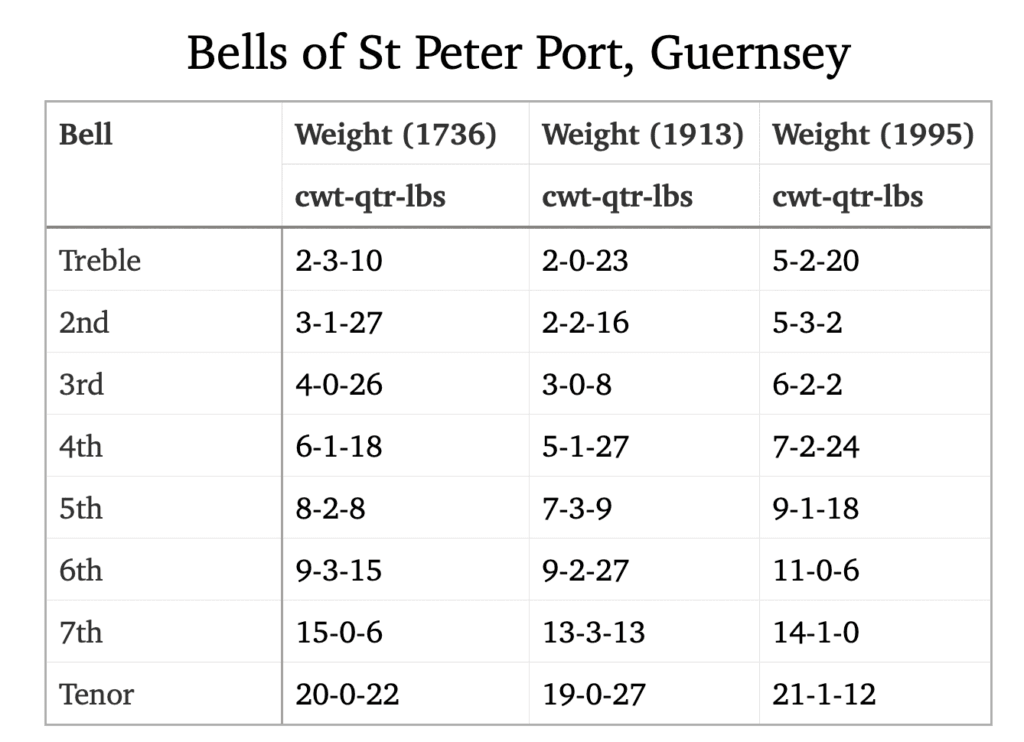
According to some articles printed in the Ringing World during the 20th century, the tower contained the first ring of eight bells hung for change ringing outside of England and Wales, from 1680. Whether this is true or not, records do indicate that in the mid-1730s, the bells were in a state of disrepair. According to the parish records, “one bell had fallen, the mountings of all are decayed and ruinous”. As a result, the services of a French bellfounder were called upon to rectify this, and it was Jean Baptiste Brocard of Lorraine who was contracted to do the repairs in 1736. Brocard recast the bells into a ring of eight with a tenor of approximately 20 cwt in the key of E, and an additional ninth bell approximately three-quarters of a ton, to act as a clock bell.
The details of the early bells can best be estimated from the inscriptions recorded on Jean’s bells, as recorded by the visit of historians in the 20th century. All eight of them carried the word ‘REFONDUE’, the six smaller bells being:
+ JE FUS REFONDUE LAN DE GRACE 1736
LE DIXIEME DU REIGNE DE NOSTRE
SOUVRAIN
SEIGNEUR GEORGE SECOND
That of the two larger ones being the same, with the following addition below:
LE VENERABLE HOMME MR JEAN BONAMY
DOYEN DE CETTE ISLE & LE REVEREND MR
ELITE DEFRESNE RECTEUR DE CETTE
PAROISSE DE ST PIERRE PORT & CE PAR LES
SOINS DE MESSRS SAMUEL DOBREE & DANIEL
DESLISLE JUNR CURATEURS MESSRS NICHOLAS
DOBREE SENR & JEAN CAREYE FILS
PIERRE CONNETABLES
LES JEAN BAPTISTE BROCARD MTRE
FOUNDEUR LORRAINE NOUS ON FAITE
Translated, the two together give more than enough indication that a ring of eight did exist before 1736, and that all of them were recast in 1736 during the reign of King George II. For a French founder to recast a diatonic ring of eight at this time is highly unusual; most French bells follow the continental system whereby the notes of the bells are often set intervals apart, rather than with change ringing, where the bells are tuned to a diatonic scale. Owing to the difficulty in the 18th century of shipping bells over water, the bells were cast in St Peter Port itself, in an area referred to as ‘Glategny’. The Glategny name is now given to a stretch of the Esplanade in the harbour, a few hundred metres from the church, which gives a clue to the area in which they were cast.
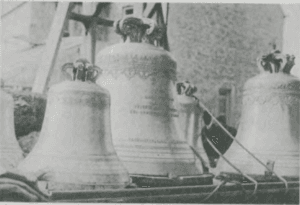
Though the bells were designed to be hung for change ringing, they were never able to be satisfactorily rung, and it is doubtful they were ever swung above a small arc. In a visit in 1907, Dr. A. D. Tyson records that several things inhibited change ringing. Firstly, the frame, which he estimated dated from 1680, was, although massive in construction, arranged anticlockwise, the fittings were primitive, the ropes fell six inches from the walls, and there were many inconsistencies in the size and scale of the fittings.
Just a few years later, in 1913, the bells were replaced again, apart from the clock bell, which remained and still remains to this day, perched on one side of the spire. As the bells rang in 1913 for the King’s birthday, their replacement arrived on the island by the S.S. Sarnia. A new ring of eight of similar dimensions was cast by leading French founder Cornille-Harvard of Normandy, also designed to be for change ringing. The bells were extremely ornamental in appearance, with lavish decorations, and giant canons. The new bells were exchanged for the old.
A band of ringers from the Guild of St Nicholas in Bristol arrived at St Peter Port shortly after to ring the first peal on the bells. The account of what they found can be found in the Bell News on 29th August 1913, and it gives a good indication that whilst the likes of Taylor’s and Gillett & Johnston were at the top of their game in England, the leading French bell foundry still had no idea about how to cast or hang bells for change ringing. The band had come to St Peter Port intending to ring a peal of Stedman Triples, but quite quickly found that such an idea was out of the question.
Even with two ringers on the tenor, a 720 could not be rung successfully, the tenor ringers being unable to keep the 20cwt tenor bell up. The ropes falling so close to the walls was another challenge, as it prevented ringers from facing into the circle, so ringers had to mostly ring by listening. Venturing upstairs, they found that whilst the bells were newly cast, and of fine tone, the trebles were much too small, being cast to chiming weights rather than ringing weights, and that the bells had merely been exchanged earlier in the year – that is to say, they were still hung on their 1736 fittings. Following several more attempts, the ringing was abandoned, although according to some sources, this was the first attempt at method ringing on the island.
The bells gradually fell into disuse and were only swung or chimed, before ringing had to stop with the Second World War. Unlike mainland Britain, the Channel Islands did not escape Nazi occupation. The ringing of bells, like many aspects of daily life, was curtailed severely. The Normandy Landings, though a success in 1944, cut off the island’s food supply from the mainland, which resulted in the near-death of everyone on the islands, both locals and Germans alike. Only with the suicide of Hitler on 3rd April 1945, was relief possible, but Liberation was not complete until 9th May. The chiming of the bells was resumed for services, but fears of damage to the building during the occupation prevented most attempts of full-circle ringing on the bells.
Fast forward to the early 1990s, and the 50th anniversary of the liberation loomed. Ideas were put forward as to how to mark this, and one idea that came up was to finally give the Town Church a ringable peal of bells. A ‘Feasibility Study Group” first met in July 1992 to investigate the possibility. As a result of their deliberations both amongst themselves and with Taylor’s and Whitechapel, it was decided that the only way of getting a satisfactory ring was to start again from scratch. The appeal target was set at a massive £130,000, which included dismantling and recasting of the 1913 bells, the bracing of the tower with a concrete grillage, and a new frame as well as all new fittings.
Undaunted, the ‘Liberation Bells Appeal’ was launched on 13th July 1993. Momentum in the project was exceptionally quick for an undertaking of this size so that by October 1993, the quotation by John Taylor & Co was accepted, and by December, the five lightest bells had already been cast at Taylor’s. Work in the tower had started in November, with the clearing of literally decades of dust, debris and decay, and the removal of seven of the bells for recasting; one bell being retained by a local museum.
In January 1994, a delegation from the project, including the dean and the architect, visited Loughborough to see the largest three bells being cast. Meanwhile, work in the tower continued, preparing it for the installation of the bells with a massive concrete ring beam, which would support the weight of the bells and the new frame. The new frame, more unusually for a modern ring, is a massive construction of iroko, a tough and hard-wearing African wood, ideal in this case because the proximity to the sea made a metal frame impractical. Interestingly, this was the largest timber frame Taylor’s had constructed since 1958.
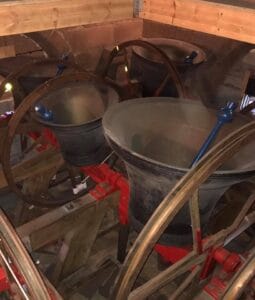
Eventually, everything came together, and the new bells arrived at the church in September 1994, early in the morning due to their size requiring the main road to be closed to traffic – those in neighbouring houses were bemused to see a giant articulated lorry reversing the wrong way down the high street at 6.30 am! The try-out later that year gave every satisfaction, and the new bells, a 21cwt Taylor eight in the key of E flat, were complimented by all. They were then not heard again until their dedication, on the 9th May 1995; the 50th anniversary of the Liberation.
The dedication day in 1995 thus brought a period of over 400 years, assuming the 1680 date is correct, to a close, from when the church first tried to install a set of change ringing bells, to when that aim was finally achieved! The bells, though cast in two batches from 1993 to 1994, all have the 1995 date inscribed within them and are one of the finest examples of a modern ring in any tower.