How a new band was created and flourished in a silent tower from both the new ringers’ perspective and that of the training team
A Student’s perspective
Shipton Gorge is a quintessential Dorset village with just 380 souls and a pretty village church perched high up with a view towards the sea. The bells had been silent (save the very occasional visiting band) for 15 years or more, most of us hadn’t even heard them ring.
Some idle chat on Christmas Eve about the village bells not ringing, led to one of those ‘well how hard can it be’ comments, and in January a short message on the village Facebook page asking if anyone was interested in giving the bells ‘a go’ got over a dozen eager non ringers who, like me, had no idea what we were entering into but were taken by the idea of the bells adding to the richness of our lovely village….and so it began.
First, I contacted a neighbouring village’s tower captain to ask for any helpful contacts, he in turn emailed the SDGR West Dorset branch training officer and soon the level of commitment required emerged, up to 3 training sessions a week! This commitment proved too much for some of those working full time with young families, or with other time-consuming hobbies; that whittled us down to 7.
Next, a training schedule arrived in my inbox with training opportunities 5 days out of seven! With the training offered at different towers and different times of day and night it seemed clear to me this could quickly become a logistical nightmare so I offered to coordinate the learners. Spreadsheets were drawn up with who was attending what, when, allowing the trainers to work out at which sessions they were needed given the number of learners. These spreadsheets were updated every ten days or so with everyone’s availability and circulated to both learners and trainers.
As we progressed different needs were identified – for example more evening sessions – and so the schedule evolved. I lost count of the number of trainers we had supporting us, but we were all in awe of the time they gave us. It seemed that whatever session we went to, day or night, there they were, giving us their all, they were genuinely amazing.
Learning to ring is difficult. Learning to ring when you are ALL new is very difficult. Each of us had times we thought we wouldn’t succeed, we thought we would never be able to ring steady rounds, raise a bell, hear our bell and so on. Our early training sessions were frenetic, five or six new learners each with a trainer, ropes sometimes snaking, lots of noise, it was challenging even though we were taught by ART methodology. As we were all in it together we supported each other, encouraged each other, shared tips of what we had found worked, and created ways to work as a team rather than simply 6 adult learners. The downside of all being learners was balanced by the bond which formed from our shared experience. (Due to personal circumstances our seventh learner could not continue).
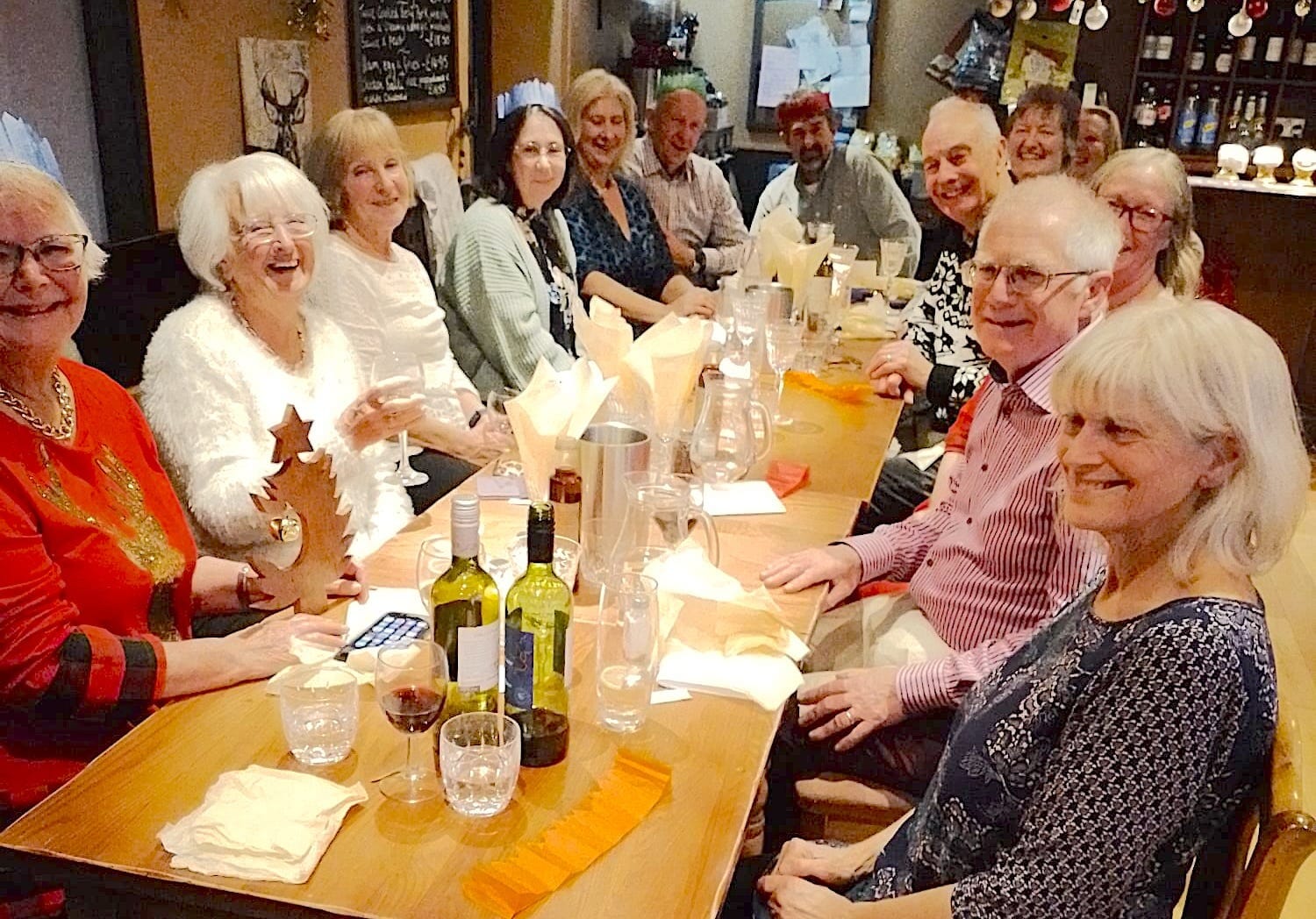
It would have been easy to forget we were doing this for fun, so we did our utmost to car share, to sometimes get together for brunch, lunch or tea and cake either before or after training, giving us opportunities to share both our frustrations and our delight when things had gone well.
Meanwhile, I also had to learn how to navigate the labyrinthine protocols of the church, who, when and how to seek permissions, including for practice night, further complicated as we didn’t have a church warden. A silent tower meant the ringing chamber had become a storage room for the church and an inspection of the bells had to be arranged. Some of the trainers acted as mentors sharing their experience, helping me with safeguarding, health and safety, and generally how to run a tower. I also invested time building strong relationships across the piste, including with the local bell hangers. There was a lot to learn, set up and organise.
I drew heavily on my experience of getting new things off the ground, building new teams and creating a positive, fun, can-do approach to everything we met.
I kept the village involved through village FB posts if anything notable was happening or had happened – visiting bands, band first QPs, new members, Ringers of the Year, us trying something new at practice, etc, and also by just being out and about, at the pub etc and talking to people, engaging when they asked ‘how are the bells?’ ; saying more than ‘yes, fine’. We’ve also done a few fundraisers, had a visiting band ring for the fete, publicizing all these events to the whole village.
Although we didn’t set off as Ring for the King learners, the coronation gave trainers and learners a valuable goal to aim for, and our first ‘performance’ in our tower was for the coronation. It was very touching to see the church full of villagers on the morning of the coronation, cheering us on, surely an indication of their sense of participation in our project and a heart-warming result of our PR efforts.
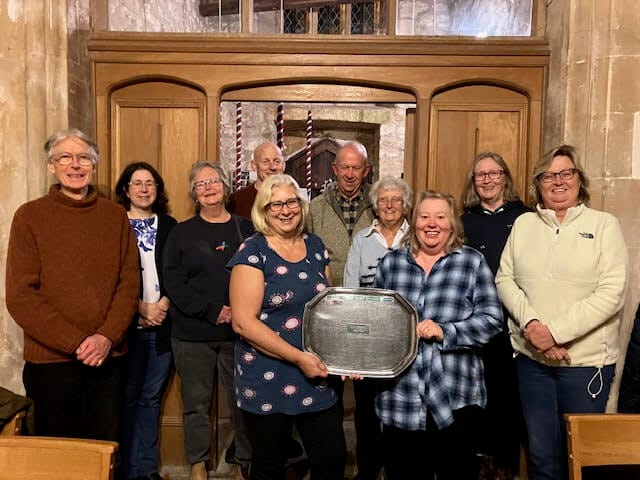
We could not have achieved any of this without good, nimble organisation, the tireless trainers, and support from the village who still critique practice nights and invariably email asking ‘what does that single bell signify’ when one of us fails to stand! The band being awarded West Dorset Branch Ringers of the Year 2023 really made it sink in quite what a feat we had accomplished.
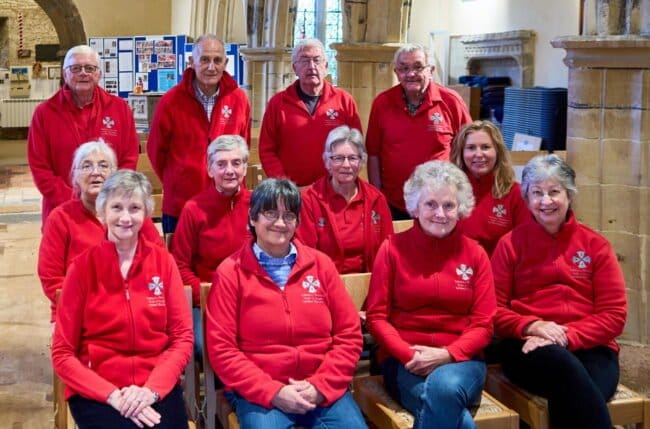
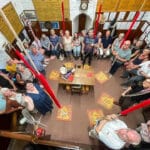
Two years down the road we still have our original 6 band members along with 3 experienced ringers from the village. We have swelled the ranks with another three new ringers and a further 2 experienced ringers recently moved in are signed up too, so from a silent tower to a hearty band of 14.
Having fun and being kind is an important thread which runs through everything we do at Shipton, visitors often comment on it. We are proud to be known for our warm welcome and our laughter.
If we’d known how hard it was going to be would we have started? Maybe not.
Are we delighted, astounded at what we have achieved and even a little obsessed by ringing – certainly!
Elizabeth Ferguson
Trainer’s perspective
As branch training officer I received a call from Burton Bradstock Tower Captain, Julian, saying that there were 12 people in a neighbouring tower at Shipton Gorge who wanted to learn for Ring for the King in May. As we were now in February we obviously needed to establish and implement a plan pretty quickly!
After hearing about the commitment involved in learning to ring this number whittled down to 8 and, following the first week of teaching 2 decided it wasn’t for them so we were left with 6 who are still all ringing 2 years later.
We felt that it was best to teach following the ART programme so that we could have continuity from the variety of teachers involved. Initially 6 ART teachers were involved but as we progressed there were usually 2/3 at each lesson.
We decided to base the teaching at Bradpole Ringing Centre to begin with as the bells were more manageable than the light 6 at Shipton and easier to silence. Some training also happened at Burton Bradstock and Bridport.
We devised a programme of training for 5 days a week initially with as many learners as possible attending. On the whole each learner attended at least 3 lessons each week.
We were lucky that Elizabeth at Shipton made sure that everyone was aware of training for each week and signed them up on a spreadsheet.
In the month before Ring for the King we transferred some of the practices to Shipton Gorge so that they became familiar with the bells.
With some support, on Coronation Day they rang their own bells. Many residents from the village and the rector came to watch and enjoyed refreshments. I brought handbells so that the villagers could also ring for the King. They were very supportive of the new ringers.
Gradually over the next 6 months we reduced the number of lessons they were having and the emphasis was transferred to the Shipton Wednesday practice night.
The band have always been encouraged to take any opportunity they can to ring elsewhere so they come to branch practices, training and other towers practices.
Two more learners have been taught over the past year.
Apart from one experienced ringer in the village they are all at a similar stage and have requested that for the time being a teacher is at their practice. Several people fulfil this.
They ring for the once a month Sunday service and other occasions.
Two of the band have attended the ART module 1 and one of those is helping to teach handling now.
Two experienced ringers have moved into the village and it is hoped they may be able to run the ringing in the future.
Overall the success of this project has been built on two main foundations: leadership and support.
– Leadership came largely from Elizabeth who instigated the idea of ringing the bells in her village. She won the support of the whole village and kept them updated on progress via the community facebook group. She talked with me regularly to find out what was needed and did all the local organisation including talking to the PCC and having the bells inspected and the belfry cleaned. It would have been very difficult to achieve RfK without her.
– Support: I was also fortunate that there were willing teachers supporting this. I was at most lessons but was helped particularly by David and Janet as well as others. Teaching a band from scratch needs to be seen as a long term commitment. If they are not given continuing support there will be losses.
Sue Carter
West Dorset Training Officer