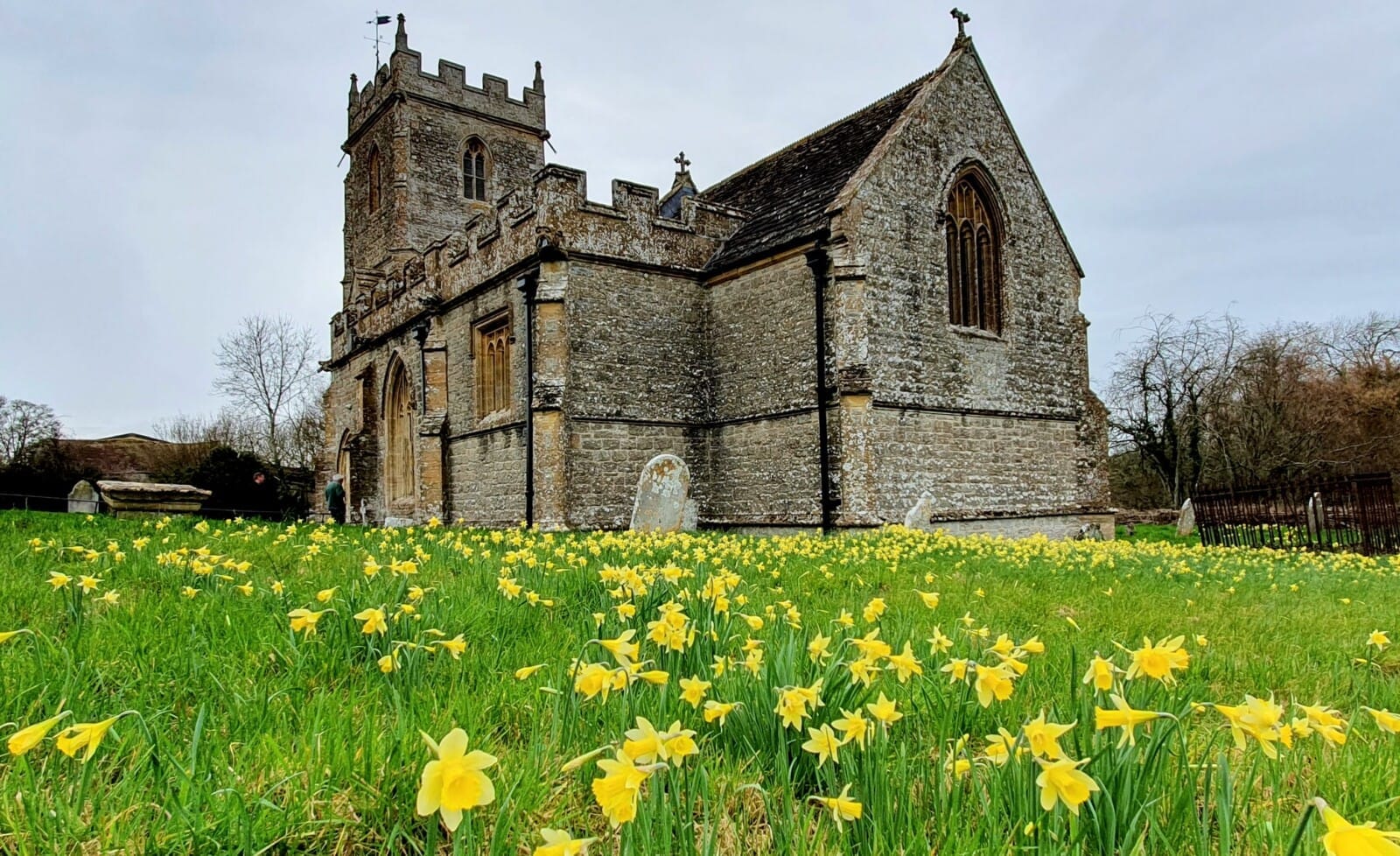
The church itself sits in the most picturesque setting, outside the main part of the village, at the end of a narrow road which goes only to the small settlement of a few farms and cottages facing the church. It is a very ancient place as there is a Holy Well (hence the name – Holwell) adjacent to the churchyard whose sacred qualities are likely to have been revered long before the advent of Christianity and whose cleansing properties would have been adopted by the very earliest Christians on the site for their rite of baptism. The settlement around the church is called The Borough, a name often associated with royal holdings of the anglo-saxon period. These holdings were, in turn, often given to the early saints as monastic settlements and it may be that this is the origin of the church on this site.
The fabric of the building dates from the 14th and 15th centuries and still has its original carved timber roof above the nave and north aisle. It has two chantries which have since been converted to the north and south isles but evidence of their existence remains in the form of two hagioscopes or squints. These small windows which look into the chancel are not, as is sometimes asserted for the poor or leprous to observe the priestly goings-on at the altar, but were made to allow the chantry priests, who were performing their Office for the benefit of the soul of a particular departed individual, to invoke the transubstantiation of the bread and wine at exactly the same time as the priest in the chancel.
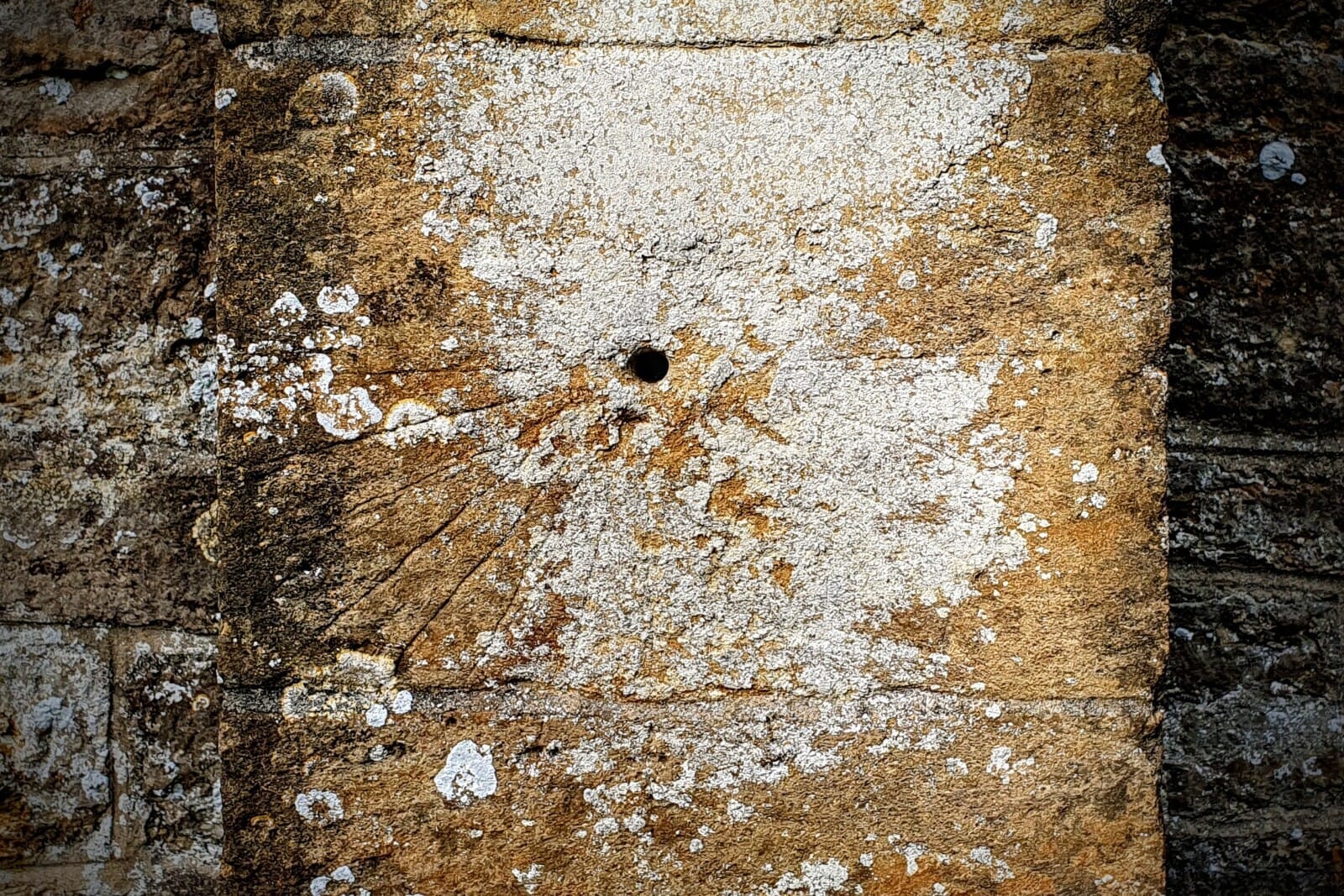
Dating from the same period, on a buttress by the south porch are inscribed two mass dials, one above the other. Throughout the Middle Ages the church emphasised the reciting of prayers at fixed times during the day, known as the Divine Offices and these small sundials ensured a village priest was able to perform the Office at the required time. Why two, though? I suspect that they are related to the chantries – the lower one relates to the first chantry but when the second was built I would guess that the new priest felt he needed a better one, or perhaps it was a condition of his contract that he commissioned one.
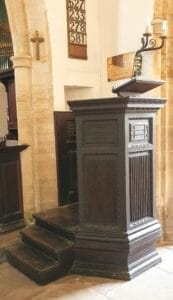
The reformation of Henry VIII and its consolidation by his son, Edward VI, swept away these chantries and the rituals which accompanied them and church services changed to more of a focus on scripture and its interpretation by preachers. It is from this protestant period that the fabulous carved pulpit, possibly Elizabethan, and the slightly later communion rail with its incorporated lecterns belong. They are relics of a major change in the way the church interacted with congregations and there were huge social tensions created by the forces for and against these changes. This is the age of people being hanged or burnt at the stake for their religious convictions as the upper hand passed from one group to the other and then back again. I often reflect that this turbulent period must have felt to ordinary people like living under our own version of the Taliban or isis; it would have been very difficult to know who to trust and many a petty dispute must have been resolved by ‘shopping’ your neighbour to the zealots.
The reformation and its turbulent aftermath created an age of uncertainty where all the old ideas were swept away so it is hardly surprising that this is also the age of witches and witchcraft and this has also left its mark on the church.
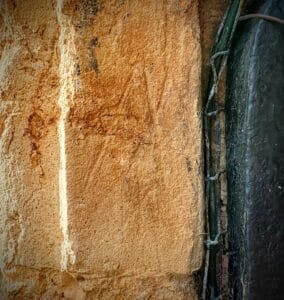
To protect buildings and their inhabitants from evil spirits and demons conjured up by witches, certain marks were often carved into the stonework close to entrances. These are often overlooked but Holwell church has two very fine examples. On the eastern stonework of the porch is a mark inscribed with a pair of roughly made compasses which is often referred to as a ‘daisy wheel’ mark where what look like petals are created by drawing half circles of t
he same circumference as the outer circle but with their central point being on the circumference itself. This is a design of witches mark which can be found in churches, barns and domestic buildings. Also known as apotropaic marks, meaning ‘to turn away evil’, they can date from the 16th century to the 19th but I suspect this is earlier in the range because it has been cut through when gate hinges were added to the porch, presumably in Victorian times, so obviously older than that.
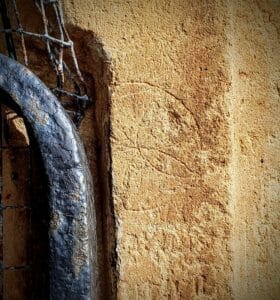
On the other side is a Marian mark, an apotropaic carving which is made from two interlocking letter Vs which invokes the power of the Virgin Mary (Virgin of Virgins) to turn away evil. Sometimes this motif is inverted, as in this case, where it also represents the letter ‘M’. It’s thought that this duplication of meaning no matter which way up somehow gave it its magical potency.
Just outside the churchyard gate are a set of stocks. This mediaeval form of punishment was generally used for fairly minor crimes (which included asking for higher wages!) and was designed to be uncomfortable and humiliating. A Statute of 1405 required “every town and village to maintain a set of stocks in which to punish vagabonds, layabouts and drunkards.” This statute updated an earlier one from 1351 which institutes this punishment for agricultural labourers who were demanding higher wages.
The use of stocks died away in the 19th century and the timbers must have been replaced in the intervening years but the iron fittings have all the hallmarks of dating to the 17th century.
If I’ve tempted you to pay this lovely and interesting church a visit I’d encourage you to go in early spring when the churchyard is filled with increasingly rare wild daffodils.