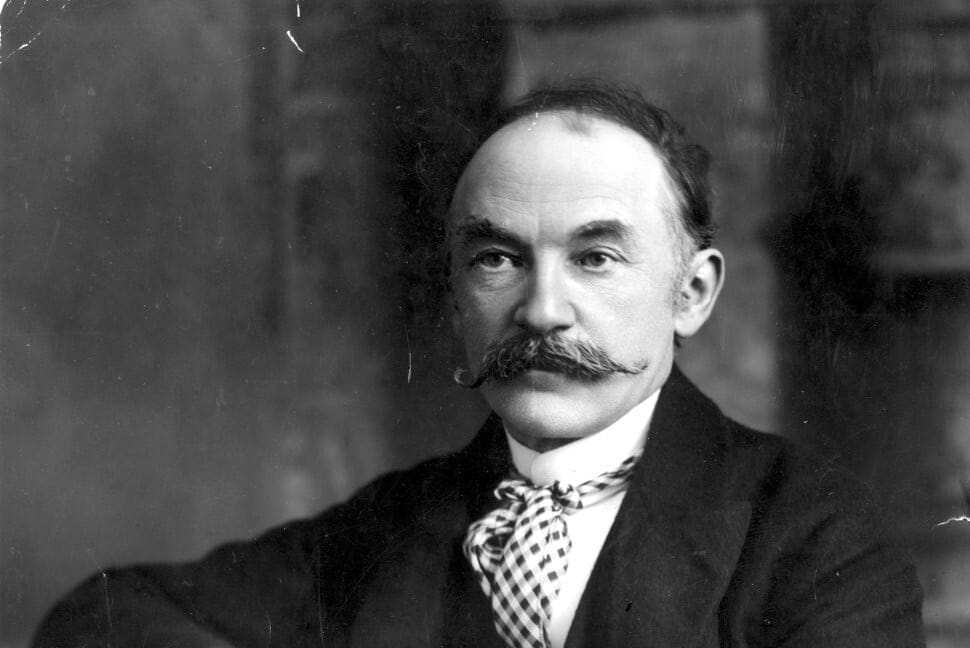
In 1925, Thomas Hardy published a poem about the recasting and rehanging of an unnamed ring of eight bells in which he leaves the reader in no doubt about his scathing disapproval of the outcome.
Inscriptions For A Peal of Eight Bells After a Restoration
I Thomas Tremble new-made me
Eighteen hundred and fifty-three
Why he did I fail to see.
II I was well-toned by William Brine
Seventeen hundred and twenty-nine
Now recast, I weakly whine!
III Fifteen hundred used to be
My date, but since they melted me
’Tis only eighteen fifty-three
IV Henry Hopkins got me made
And I summon folk as bade
Not to much purpose, I’m afraid!
V I, likewise, for I bang and bid
In commoner metal than I did
Some of me being stolen and hid.
VI I, too, since in a mould they flung me
Drained my silver, and rehung me
So that in tin-like tones I tongue me
VII In nineteen hundred, so ’tis said,
They cut my canon off my head
And made me look scalped, scraped and dead.
VIII I’m the peal’s tenor still, but rue it!
Once it took two to swing me through it.
Now I’m rehung, one dolt can do it.
(Human Shows 1925)
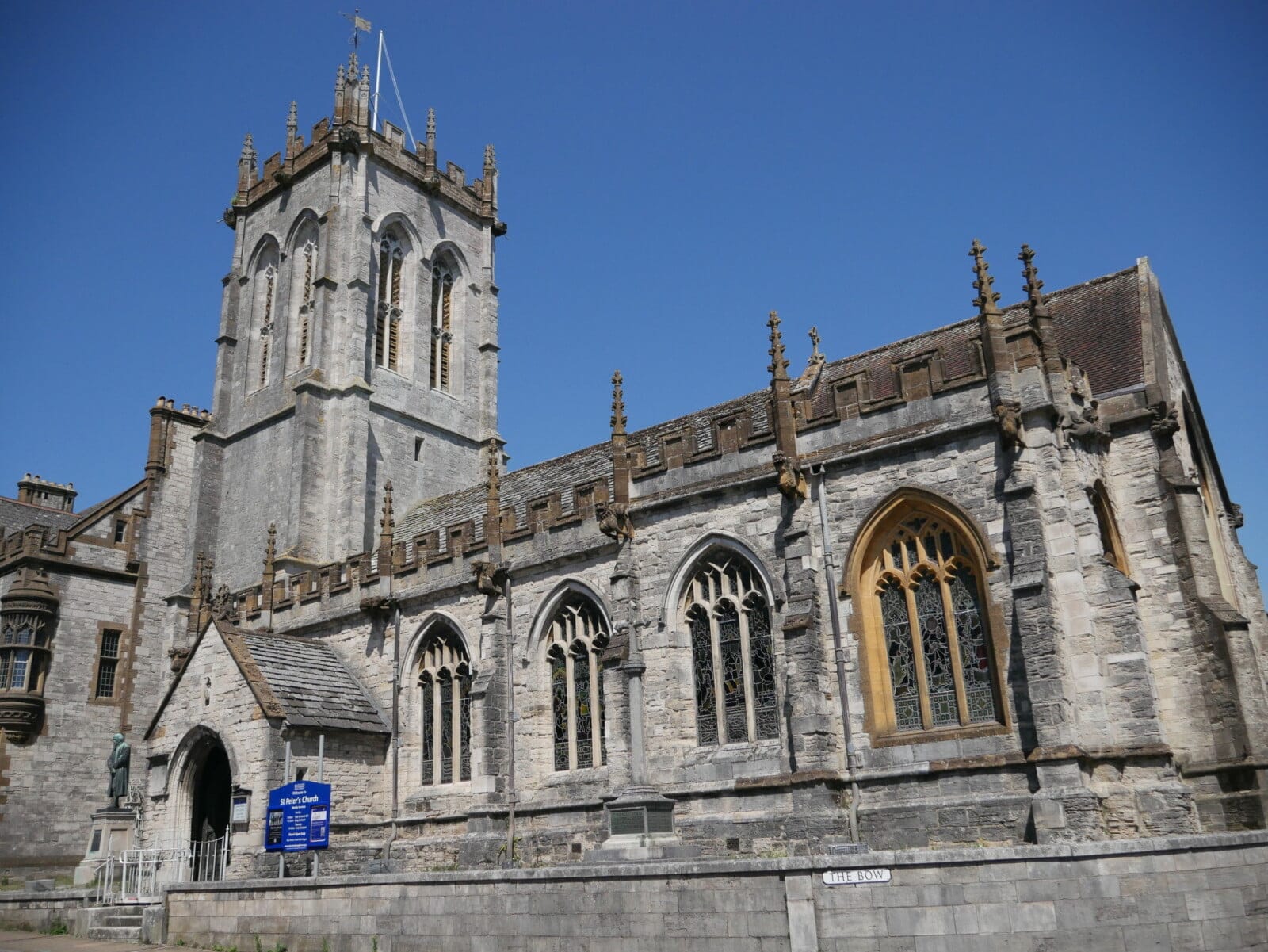
Hardy discretely avoids identifying the tower in question but some background knowledge of his life might lead the reader to suppose that the bells referred to could well be those of St Peter’s, Dorchester.
Although we can never be certain that this is the case, we do know that the bells of St Peter’s were restored in 1889 and that Thomas Hardy was very familiar with them given the close proximity of the church to his earlier office and many of his literary locations, especially in The Mayor of Casterbridge.
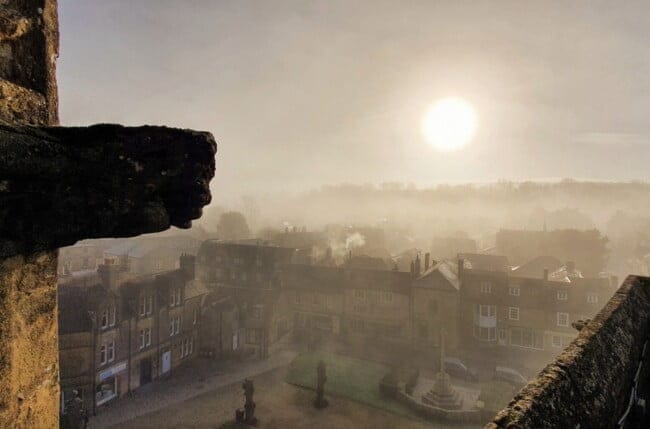
Hardy had, in 1884, returned to Dorchester to live in the home he had designed (and his brother, Henry, built). In the same year he became a Justice of the Peace and served as a magistrate in the Court House less than a hundred yards up the hill from St Peter’s. It follows that it is likely that he was familiar with the sound of the bells both before and following the rehanging; indeed, on New Year’s Eve 1884 Hardy had paid a visit to the ringing chamber of St Peter’s, recording the occasion in his diary. In the entry he notes his own father’s admiration of the tone of the tenor:
“To St. Peter’s belfry to the New Year’s Eve ringing. The night wind whiffed in through the louvres as the men prepared the mufflers with tar-twine and pieces of horse cloth. Climbed over the bells to fix the mufflers. I climbed with them and looked into the tenor bell: it is worn into a bright pit where the clapper is battered with its many blows.
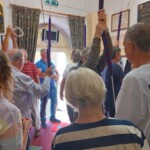
The ringers now put their coats and waistcoats and hats upon the chimes and clock and stand to. Old John is fragile, as if the bell would pull him up rather than he pull the rope down, his neck being withered and white as his neckcloth. But his manner is severe as he says “Tenor out?” One of the two tenor men gently eases the bell forward – that fine old E flat, my father’s admiration, unsurpassed in metal all the world over – and answers “Tenor’s out”. Then old John tells them to “ Go!” and they start. Through long practice he rings with the least possible movement of his body, though the youngest ringers – strong dark-haired men with ruddy faces – soon perspire with their exertions. The red, green and white sallies bolt up through the holes like rats between the huge beams overhead .
The grey stones of the fifteenth century masonry have many of their joints mortarless, and are carved with many initials and dates. On the sill of one louvred window stands a great pewter pot with a hinged cover and engraved: “ For the use of the ringers”
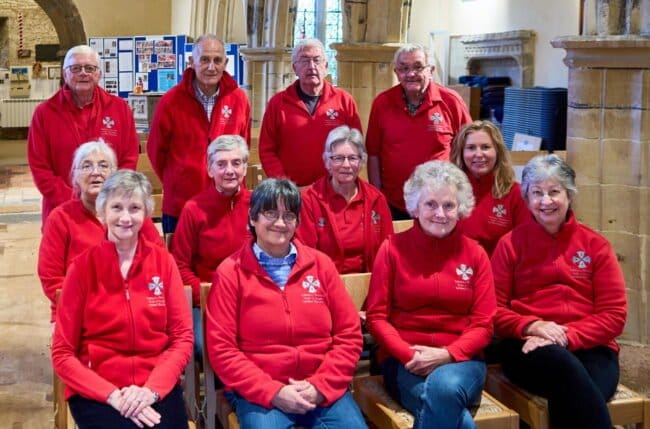
Sadly, the pot is no longer used by the ringers (the copious consumption of alcohol while ringing being inexplicably frowned upon today) who are now in the habit of retiring to the King’s Arms or Blue Raddle after practice, although the tankard still exists and is kept in Dorchester Museum.
Anyone who has read Thomas Hardy novels will recognise a theme of old-better-than-new and we also know from his personal correspondence that he was particularly unhappy with the recent trend of cutting off canons to enable the bell to be more easily swung full circle and with what he saw as the unnecessary recasting of ancient bells.
If his poem does, in fact, refer to the bells of St Peter’s, many who have enjoyed ringing there may well, like me, feel that he somewhat overstated his appraisal of the work completed for reasons of dramatic emphasis.
Andy Waring
(Hardy’s ringing connections and in particular this poem were brought to my attention in an excellent article written by Gareth Davies originally published in the Ringing World on 22/29 December 1989, for which I am most grateful)