Church of St Peter ad Vincula, Tollard Royal, Wiltshire
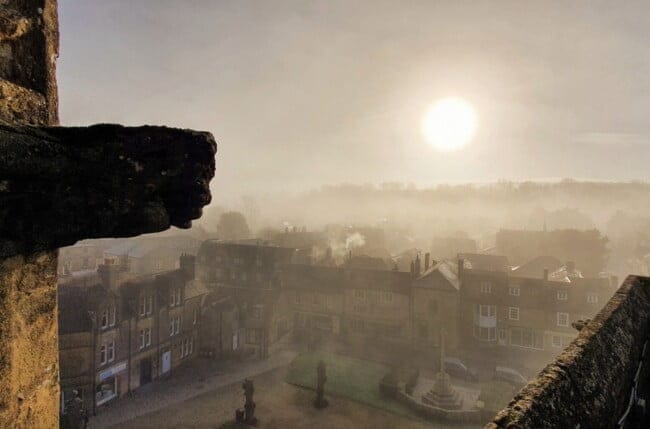
Tollard Royal is one of the oldest, and prettiest, villages in Wiltshire, nestled under the steep chalk escarpment of the Cranborne Chase.
There is much evidence that this area was inhabited from the very earliest prehistoric times and the existence in the parish of a later neolithic (2400 – 1500 BC) bowl barrow attests to a very early development of the village. The village appears in the Domesday Book (1086) as Tollard, held by the Sheriff on behalf of the king during the reign of Edward the Confessor. The land around the village was for centuries part of a larger royal hunting ground used by successive monarchs, King John building a royal hunting lodge in the village, and the Royal suffix came into use in the 16th century to emphasise its royal pedigree. The association with King John is still seen in the village today, with the local pub called the King John Inn, as well as a large, Tudor mansion behind the church also carrying his name.
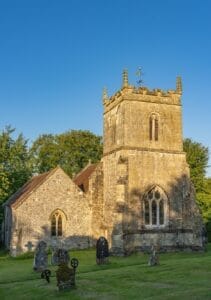
The oldest building in the village is undoubtedly the church, dedicated rather more uncommonly to Peter ad Vincula, meaning Peter in chains, referring to the Bible story of Peter’s liberation from Herod; one of only fifteen in England to have this dedication. The present building was founded in 1291 and evidence of this foundation is seen in late 13th century windows, and the style of the tower arch, in the nave, which all bear hallmarks of late 13th century or early 14th century Early English and Decorated Gothic styles. The core of this work still survives today, but the building has, like almost every church in the country, been expanded and rebuilt several times. In 1412, the tower was added thanks to a gift of £10 from a mysterious benefactor, and later, the entire building underwent much remodelling in the Perpendicular Gothic style: the tower and nave were both heightened, an aisle added to the nave and new windows inserted.
The modest west tower of the church has had bells at least as far back as Edward VI’s 1553 Church Goods Survey when three bells and a sanctus bell were recorded. All three of these bells were medieval castings, comprising at least one by the Salisbury foundry, and the tenor by William Dawe of London, who according to Dove’s Guide, was active between 1381 and 1418. These three bells remained this way until the second was recast by William Toiser of Salisbury in 1728, followed by Dawe’s tenor bell, by Mears & Stainbank, in 1882. The old bell’s inscription was approximated on the new bell, though the inscription band from the old bell was preserved by being incorporated into a chandelier at King John’s House, immediately south of the church. These three bells were hung in a large timber frame, with an anticlockwise rope circle, possibly 16th-century in origin.
In 1889, Mears returned and cast two new treble bells, to augment the ring to five. Owing to the large frame for the heaviest three bells occupying all of the floor space in the belfry, the new trebles were hung in a wooden frame extension above the other bells, on the west side of the belfry. Mears had already provided new fittings for the original three in 1882, and the new trebles were supplied with similar fittings. Any ringing that did occur here was short-lived, and by the late 20th century, the bells had not been rung full circle in living memory – it is possible they never were. Though the bells had been fitted with full circle running gear by Mears in 1882/1889, by 1997, the heaviest three had deteriorated to such an extent that even chiming was unsafe; only the two smallest bells were swung in a small arc.
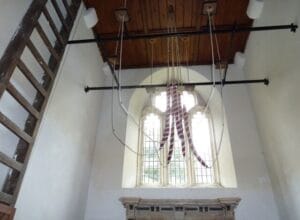
The launch of the Millennium Fund to restore rings of bells for the 21st century gave hope that full circle ringing might be revived in the village. The bells were inspected by both Taylor’s of Loughborough, and Nicholson Engineering of Bridport from 1997 to 1998. Though the recommended course of action differed a little between the two of them, both firms condemned the frame and fittings as unsafe, as well as the lack of accurate tuning in the bells. The frame by this time had rotted severely, and one of the firms recommended placing beams in the pits to ‘catch’ them, should they fall from their hangings! Nicholson’s gave options for rehanging the bells for chiming only in a new frame, or their replacement with a new ring of bells for change ringing. The replacement ring options were given as a ring of six, with a tenor of either 5.25 cwt in C, or 7 cwt in B flat. Taylor’s main course of action was to remove the canons from all the bells apart from the third and fourth, which were both listed due to their age, sensitive tuning and rehanging all with new fittings in a new frame. There was an option for both a new tenor bell and a new treble bell to augment the ring to six, noting that the former was undersized.
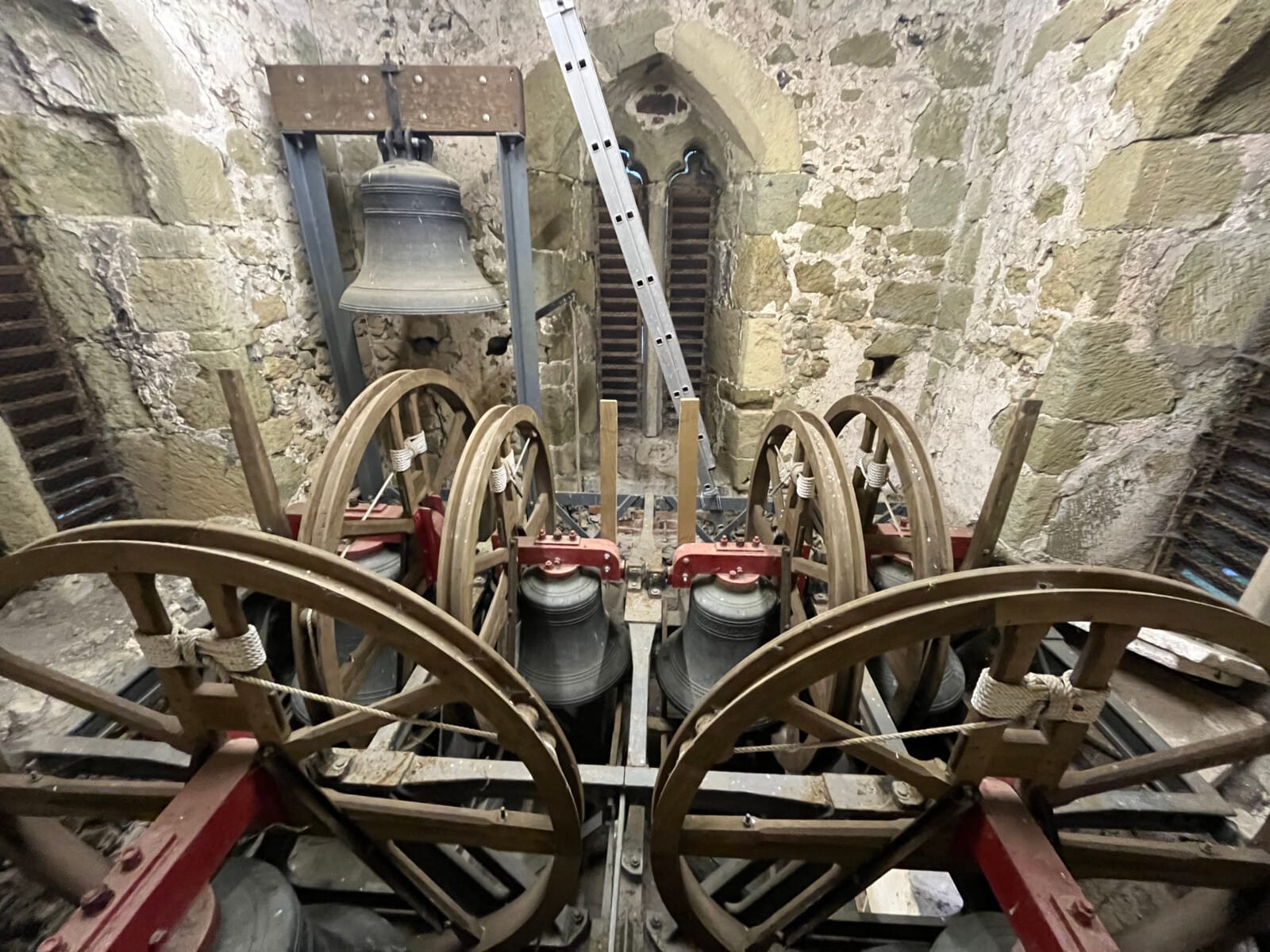
The quote by Nicholson’s for a new 7 cwt ring of six in B flat was accepted, with the casting and tuning of the bells sub-contracted to Whitechapel, after which they would be delivered to Nicholson’s Bridport works for fittings and hanging in their new frame. The casting of the bells took place at Whitechapel Bell Foundry’s London premises in 1999. To help fund the project, the parish successfully applied to the Millennium Fund, and consequently, their logo and text appear on the shoulder of every bell. Several donors gave individual bells, and their names were recorded on their respective bells. The bells are hung in a modern cast iron ‘lowside’ frame, with four bells swinging north to south and two east to west. They are hung on modern fittings, including metal headstocks, ball bearings, hard plastic pulleys, and traditional wheels, stays, and sliders.
Unusually for a derelict ring that contained three Victorian bells, all five bells escaped recasting. The former third was kept by the church due to its age and was rehung in a steel pedestal frame above the new tenor on a new deadstock for chiming. It has been quarter-turned and retains its canons. The former fourth was also kept by the church initially, before being loaned to the Larmer Tree Estate at the other end of the village. It was stolen before it could be returned to the church, and its current whereabouts are unknown.
The three Victorian Mears bells were all re-homed. The former treble initially went to All Saints, Speke, near Liverpool, but it was never hung there, and eventually became the third of a ring of six at Northington, Hampshire, in 2018. It was retuned down to E flat, and now weighs 3cwt 1qr 20lb. The former second and tenor bells were re-homed rather more unusually. The Keltek Trust received an inquiry from the Royal Opera House at Covent Garden, asking for two bells for a performance in Vienna, with a short turnaround. Their requirements could be met by the former second and tenor from Tollard Royal, which were retuned and shipped to Vienna within a few weeks.
The present ring of bells, a light and musical modern ring of six, are a delight to ring, amongst the fine setting of the Cranborne Chase.