The purpose of this article is not for the SDGR to tell any ringer what to do, but to update all our members on the latest position of the churches we ring in regarding safeguarding training.
It explains the new safeguarding training requirements that the Church of England and Diocese of Salisbury expects of anyone who rings church bells.
It is important to remember that whenever we ring church bells we do so with the permission of the incumbent and that he or she is entitled in law to withdraw that permission at any time.
It’s worth taking a moment to acquaint ourselves with the background to that law. The Church of England conducts its governance through something called Canon Law which has the power of law within the church of England. General laws passed by parliament are the ones that most of us are aware of and these are called Statute Law. Sitting in between Statute Law and Canon Law are something called Measures. These are laws which originate in the Church of England but are approved by parliament.
Section 5A of the Safeguarding and Clergy Discipline Measure 2016 (which was inserted by the Safeguarding Code of Practice Measure 2021 and took effect in March 2022) fundamentally changed Church of England safeguarding law by replacing the old duty to “have due regard” to safeguarding guidance with a strict legal duty to comply with the House of Bishops’ Safeguarding Code of Practice.
For “authorised volunteers”, such as bellringers, Tower Captains, and ringing instructors, this means that the church’s position on ringers’ compliance with safeguarding policies is no longer optional or subject to personal discretion. Ringers need to be aware that, under this Law, “relevant persons” (like clergy, churchwardens, and Parochial Church Councils/PCCs), hold the direct legal “duty to comply” with the Code. They face disciplinary action if they fail to enforce safeguarding in their parish.
So what are the Safeguarding Training requirements for ringers?
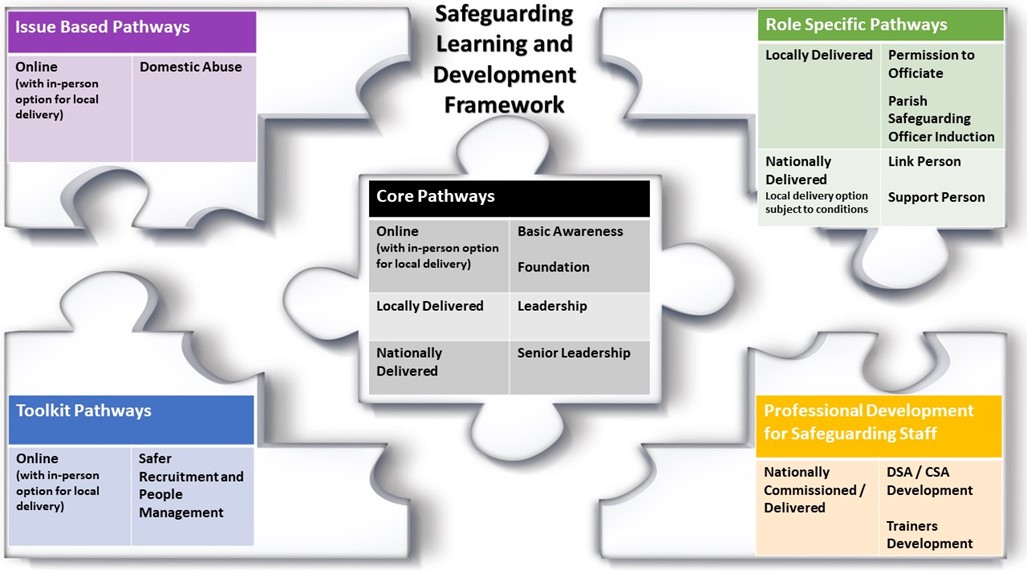
Happily, they are not too onerous and consist of online learning modules which are available on the Church of England Training Hub.
All ringers are required to undertake Basic Awareness Training. As an interim measure for SDGR members, by reading the Diocesan Safeguarding Leaflet (available from your PCC) the reader will have been deemed to have completed the requirement of the Basic Awareness Training for a three year period after which the online course must be completed. Additionally, the church requires its ringers to revisit this training every three years.
Additionally, Tower Captains, Instructors, and Practice Leaders (anyone who teaches bellringing, leads a practice, acts as a ringing instructor, or serves as a ringing group leader) must complete the Foundation Training module in addition to the Basic Training.
Important Rules and Renewal Timelines
- Three-Year Refresher: Safeguarding training is not a one-time event. We must repeat and refresh our training at its highest required level every 3 years.
- Mandatory Church Context: Even if you have completed safeguarding training for your profession (such as a schoolteacher or doctor), you are still legally required to complete the Church of England modules, as they are specifically tailored to the church environment.
- How to Access Training: Basic and Foundation modules are completed online through the National Safeguarding Training Portal. Higher-level Leadership training is managed directly via the Salisbury Learning Hub.
Frank Marshall & Andy Waring
Guild Safeguarding and Communications Officers