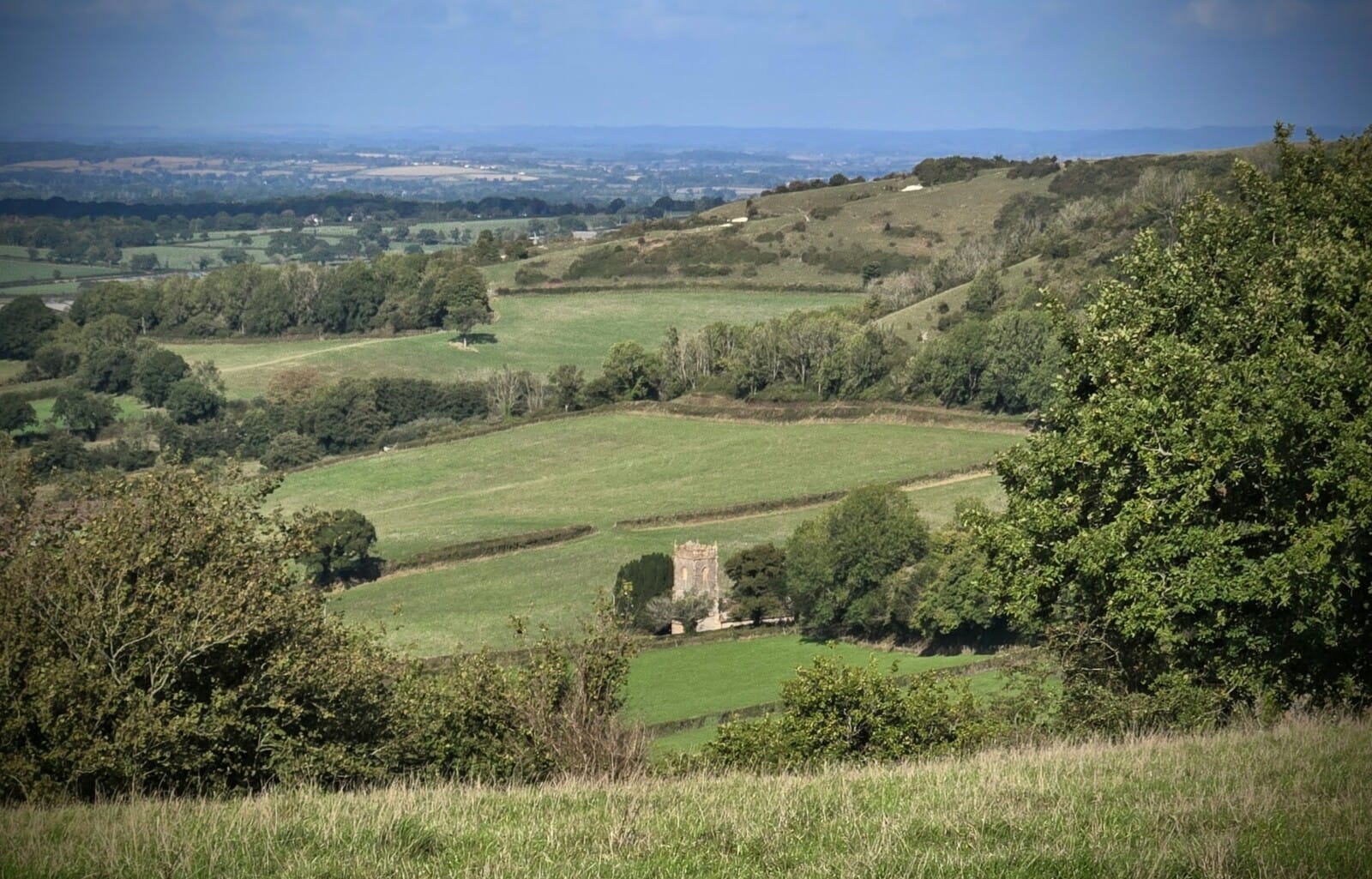
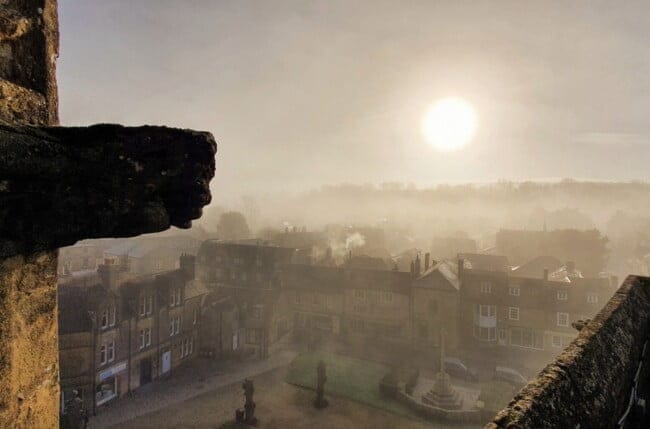
Batcombe is a tiny community of around 60 souls which nestles in a fold in the northern escarpment of the North Dorset Downs. It has a small and lovely perpendicular church with a distinctive early 15th century tower which houses an important historic bell which has recently undergone a remarkable restoration and augmentation.
The first mention of the bells is in the Inventory of Edward VI in the 1550s when four bells are recorded. The next mention is in 1827 when again there are four bells though presumably two had been recast in the interim as two of these date from the later 16th century. Later, in 1864, when substantial restoration work was going on at the church, one of these bells which was severely cracked was sold to pay for the rebuilding.
The remaining three seem to have been in good order at the time of this Victorian restoration as no mention is made of any damage but by 1940 they were all described as cracked or broken.
In 1952, the Royal Commission on the Historical Monuments of England described the poor state of the bells adding that “the bell-frame is old”. A few years later in 1956, a report by Mears and Stainbank of the Whitechapel Bell Foundry clearly spelled out the serious deterioration.
“The largest was probably cast by one of the Bilbie family of Chewstoke. It is cracked, and an iron band has been fastened round the crown for safety. The band covers the inscription.”

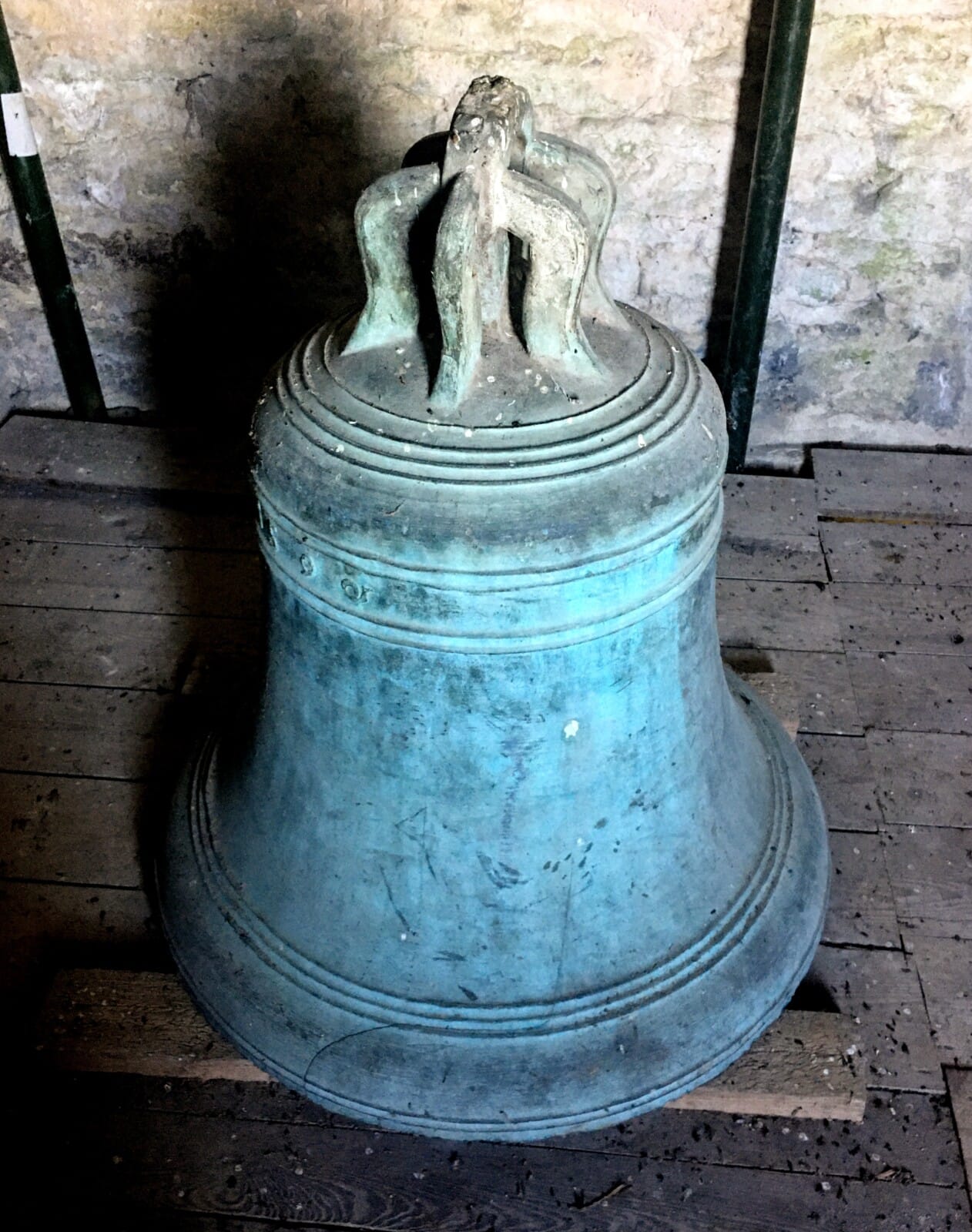
“The middle bell was cast in 1592 by William Warre, of Leigh, (your own parish). It is badly cracked.”
The report also describes the smallest as being “unfortunately in pieces” but puts it in the late 14th or early 15th century and bearing the inscription: STA MARIA MAGDALENE. The story goes that this bell, cracked beyond salvation, was broken up by a local farmer to be sold as scrap for the war effort but its sale was forbidden by the then incumbent so the broken pieces were gathered together, though sadly left in a pile outside the church.
The report describes the weights of the three bells as 11 ½, 7 ½ and 5 ½ cwt respectively and goes on to recommend that all three should be sold and a single bell purchased which they suggested hanging stationary for chiming. The estimate for the value of the old bells as scrap for the total combined weight of 24½ cwt being £480 and the cost of the replacement, £177, leaving a tempting surplus of £303 for parish funds.
Happily this proposal was not taken up in full and the Warre bell was retained while the larger and smaller were melted down and from the metal was recast a new bell of 4 ½ cwt. In view of the surplus metal, Whitechapel paid the parish £95/3s. However, as this sum wouldn’t cover the rehanging, a decision was taken not to go ahead with it at this time although it does seem that there was every intention to do this as holes had been inserted into the walls of the belfry so as to provide bearings for two steel beams to be fitted to carry the chiming bell. Presumably the “old” bell frame was removed at this time in anticipation of this work as it no longer existed by the 1970s.
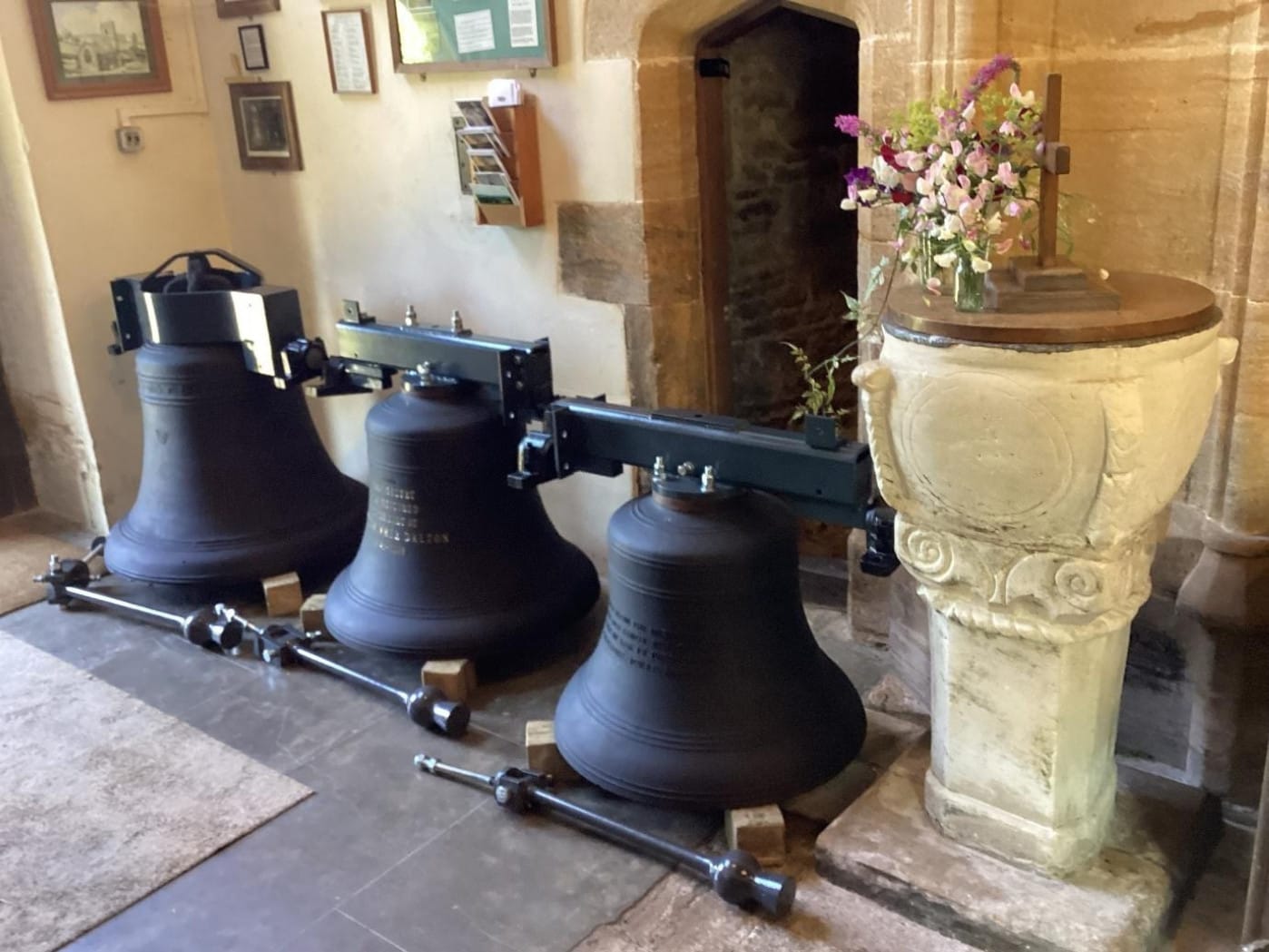
In the meantime, the bells were stored on display in the back of the nave where they stayed for over 15 years.
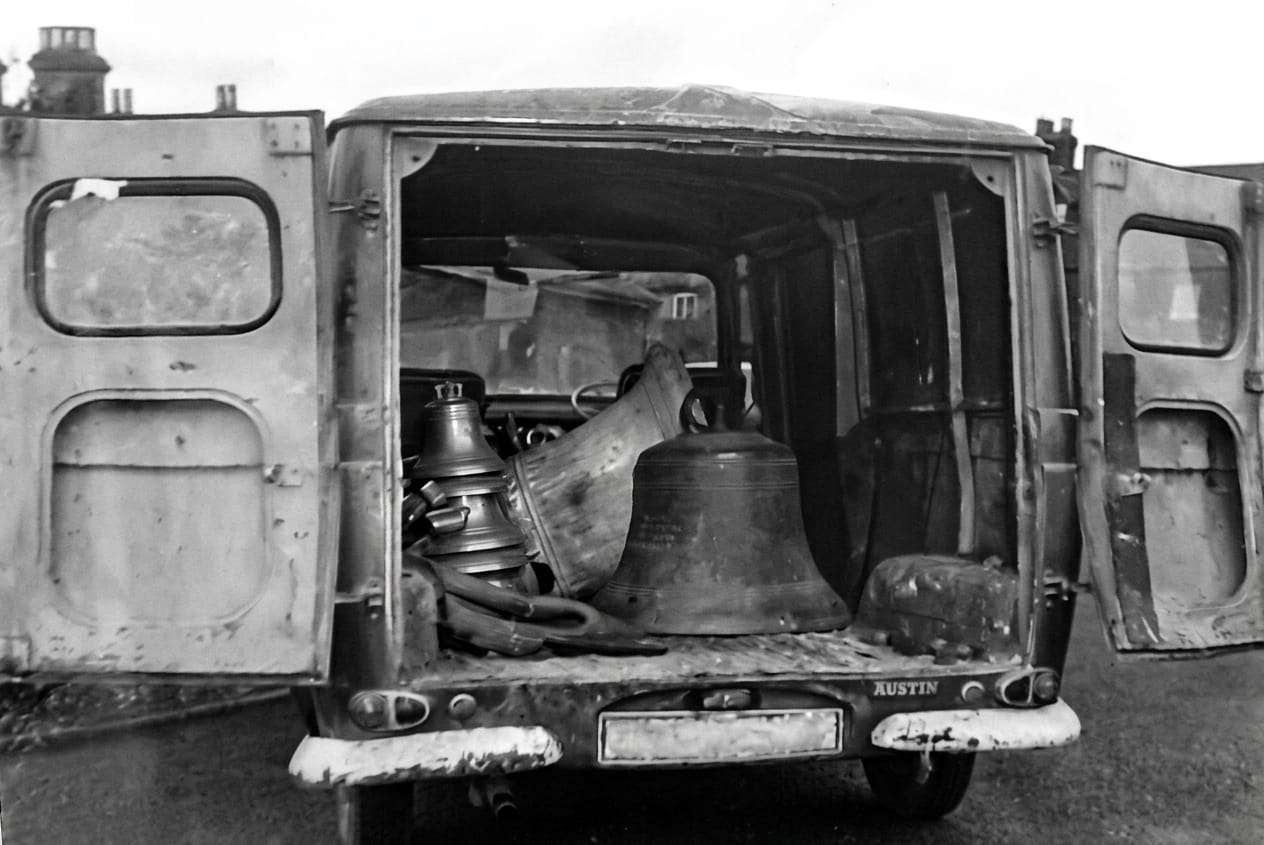
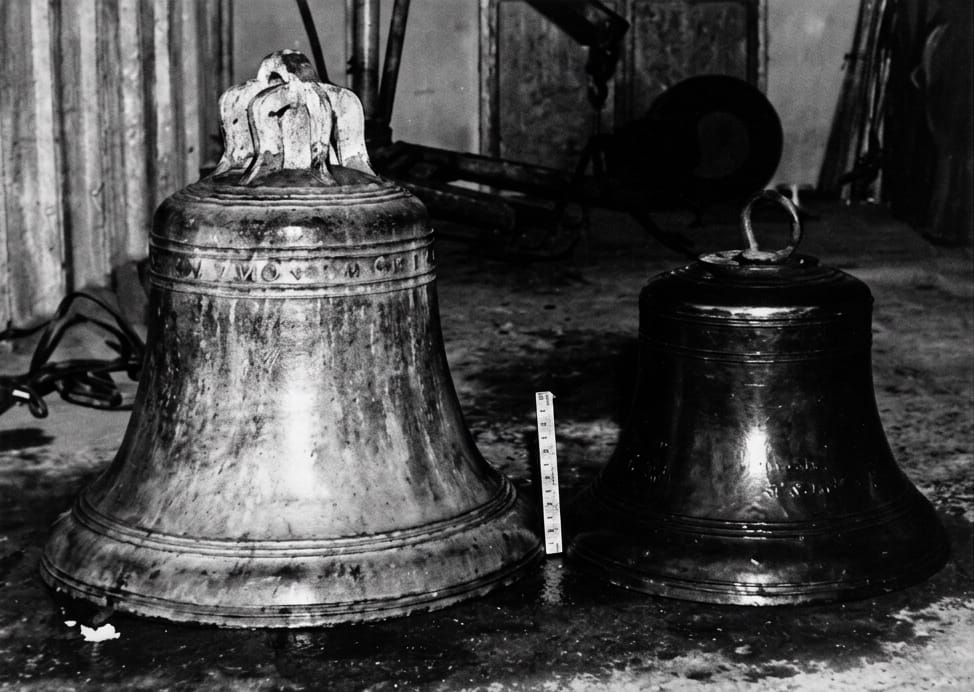
In early 1973 the bells were stolen! Scratches can be seen on the pew ends where the bells were dragged along the aisle. The alarm was raised and an observant policeman, PC Ball, stopped and searched a van near Ringwood, which clearly had a very heavy load in the back. There is a photo from the time of the two bells in the back of the van along with some other smaller bells – bells seeming to be a particular speciality of the thieves.
The bells were recovered to Sherborne police station from where churchwarden, Mr Vardy, made arrangements for Whitechapel’s William Hughes to inspect them for damage and to visit the church to make new plans for hanging the chiming bell and safer storage of the Warre bell.
Mr Hughes’ report states that he found them in much the same condition as they were before being stolen and provided a quotation for £284 which included collecting the bells from Sherborne police station, opening up trapways, inserting the girders, hanging the chiming bell and hoisting the Warre bell into the middle chamber, below the bellchamber. This work was completed in October 1974 and the single bell was chimed for services for the next half century.
This was the position when Christopher Dalton visited while doing research for his seminal Bells and Belfries of Dorset which was published in 2005. He was taken by the picturesque location but concluded:
‘That, at the time of writing at least, is the end of the long and in many ways sad story of the bells at this remote church with its distinctive tower, in a memorable setting in a fold in the hills above the hamlet of Batcombe.’
Although he doesn’t spell it out, his friends believe he would have taken a dim view about bells intended for full circle ringing being hung from a girder for chiming, as further evidenced by his comments on the emptying of Alton Pancras belfry of all of its old framework and its replacement by a ‘dead’ chime on a single steel beam.
In his professional life Christopher Dalton was a renowned architectural photographer having had three exhibitions at the Victoria and Albert Museum and published by, amongst others, the National Trust and Pevsner, but he was also a renowned national authority on churches, church bells and historic bell frames.
Following his untimely death, age 66, in 2008 (see obituary here) and the publication of the Exploring England’s Belfries book which features a collection of his photographs (including one of Batcombe) and an introduction and notes by his friend Richard Jones, discussions between Richard and the Dalton family on how to best direct proceeds from the publication settled upon repairing the Batcombe Warre bell as a highly appropriate memorial.
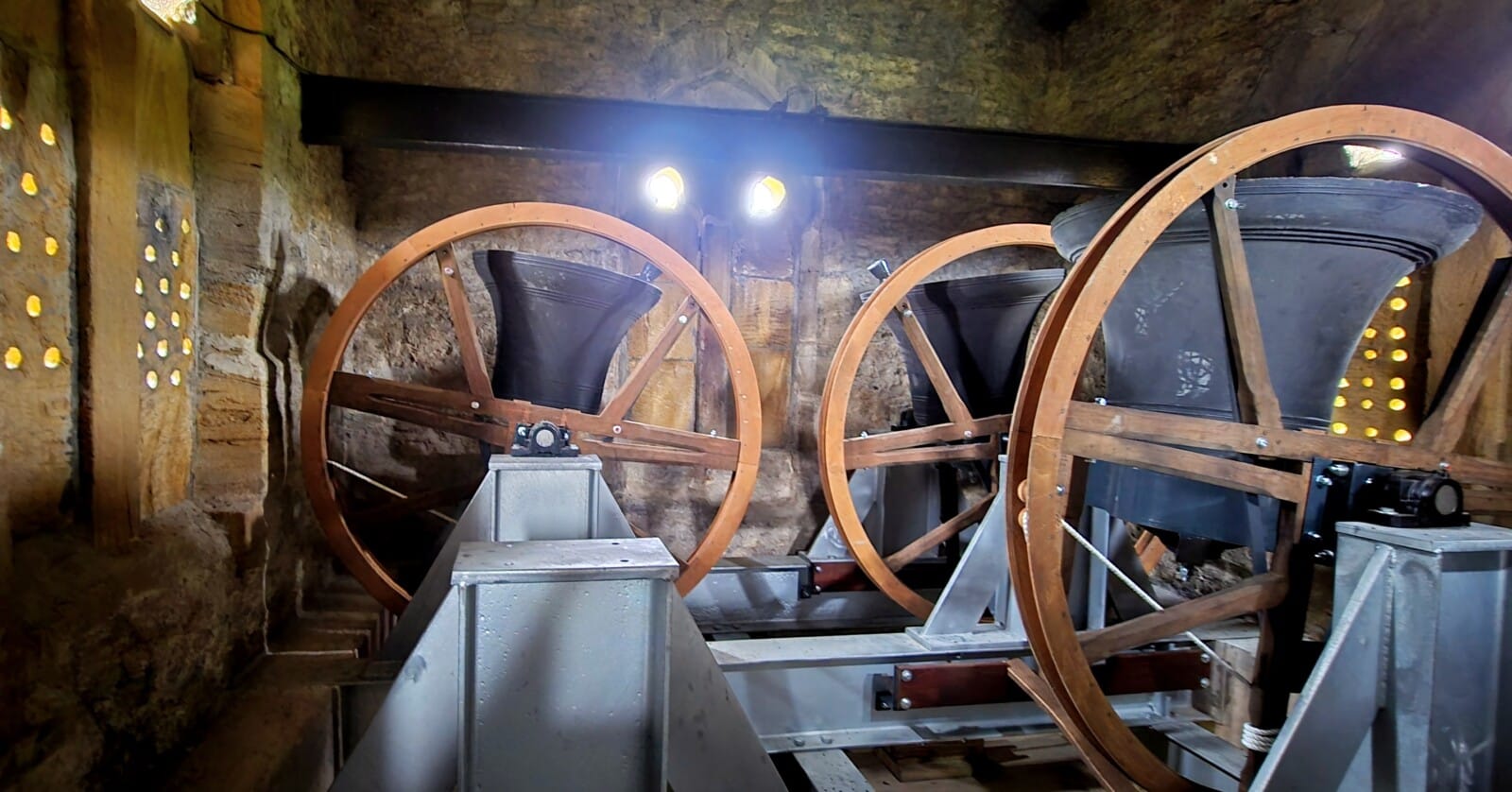
Enthusiastically supported by the Batcombe church officers, and with further funds provided by friends and members of the Dalton family, an appeal in the Ringing World and a variety of trusts including the LEBRF, in 2022 specialist welding was carried out by Soundweld. Bellhanger Matthew Higby, who knew Chris, undertook the organisation of this work and offered, as a personal tribute to Chris, to install a frame and to hang this and the other bell for full circle ringing, waiving his usual charges.
With an eye to possible future augmentation, Matthew designed and constructed a frame capable of supporting six bells and, in the meantime, the Keltek Trust came into possession of a surplus Gillett & Johnston bell from Roman Catholic church of St Thomas of Canterbury and English Martyrs, St Leonards on Sea, Sussex, originally cast in 1935, and offered it to Batcombe as it was the right size and tone to sit between the existing two bells to create a diatonic ring of three. The LEBRF provided a further grant for the fittings for this bell and the church was able to accept Keltek’s generous offer. The bell bears the inscription:
THIS BELFRY WAS RESTORED IN MEMORY OF
CHRISTOPHER DALTON 1941-2008.
Three further bells have been identified by Keltek and Matthew to enable an augmentation to a ring of six and fundraising has now begun for this next phase which it is hoped will be completed in 2027.
As a further note of interest, the pedestal frame includes elements reused from the ring set up in the Thames barge that sailed down the Thames in the Diamond Jubilee pageant in 2012.
The new installation was first rung by Matthew Higby, Dave Kelly (Keltek Trust) and friends on the 7th August and, following a brief practice and test ring on the 12th September, a group of ringers from Sherborne Abbey rang the bells for their first “official” performance at the church’s Harvest Festival service on the following day.
Andy Waring