Within the Dorset portion of our Guild are 21 surviving bells housed in 18 towers which are attributed to bell founder William Warre. He plied his trade out of Leigh in the heart of the county during the reigns of Queen Elizabeth I and James I during the very early days of change ringing.
Where exactly in Leigh his foundry was is unknown but extensive research done by church bell historians H.B. Walters and J.J. Raven identify several characteristics which are hallmarks of his castings including an intertwined WW signature and a unique letter I which has the appearance of a fleur-de-lys. Beyond being based in Leigh, nothing is known of his life but the dates of his bells span three decades from 1590 (Lillington) to 1618 (Over Compton).
With weights ranging from 5 cwt to 14½ cwt, it is believed that all Warre’s bells were cast in Leigh and then transported to the tower where they were to be housed on a cart drawn by horses or oxen. A glance at the map illustrates the limits of transporting large and heavy objects at the time.
How he interacted with other local bell founders such as the Purdues of Closworth, George Poole of Yetminster or the Wisemans of Montacute is unrecorded, but given such a concentration of bell founders in such a relatively small area, it seems highly likely that one of them learned the craft from the other, perhaps as an apprentice, before starting out on their own account.
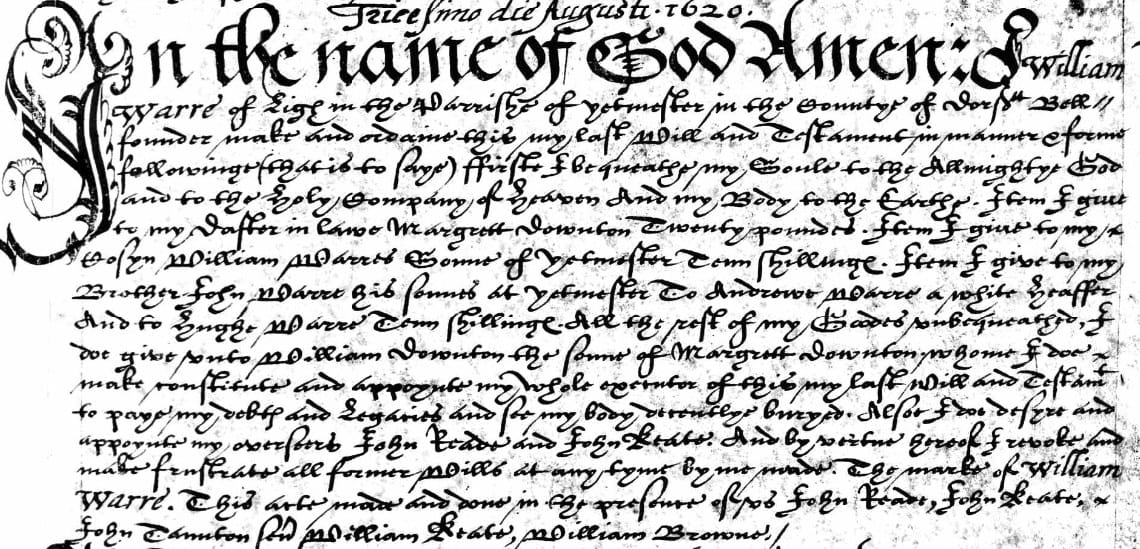
William Warre died in 1623 and in his will he left £21 and a white heifer which was a tidy sum at the time, being the equivalent of 400-500 days of wages for a skilled craftsman and might be the economic equivalent of £100,000 today.
Of his surviving bells, thirteen are hung for full circle ringing in eleven towers, four are hung for chiming in three towers and four are in unringable towers of three or four bells.
I always feel it is a privilege to ring on an instrument that was created such a long time ago, and which has such strong links with the origins of our craft.
Andy Waring
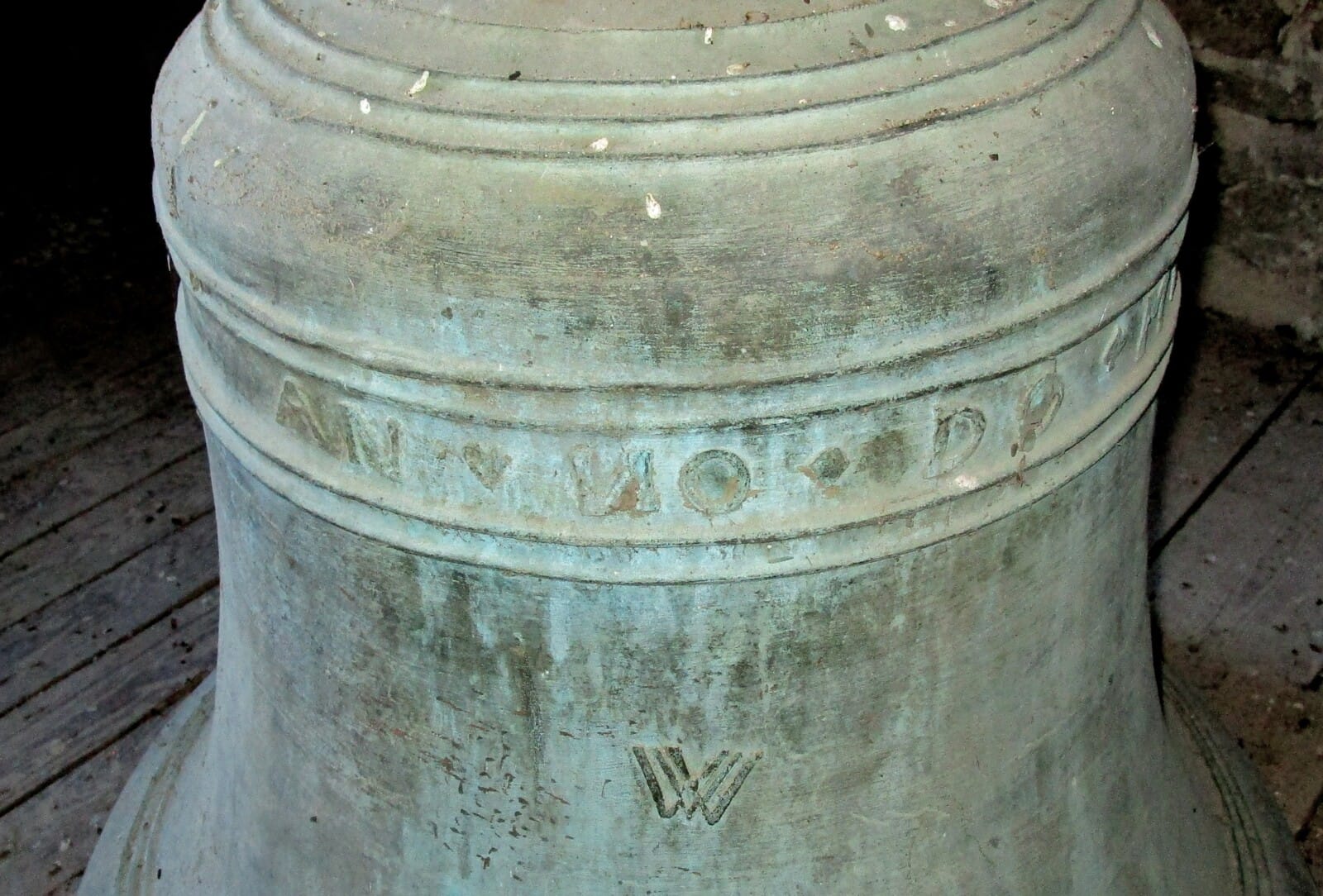
William Warre bells
Details courtesy of Dove’s Guide
| Tower | Bell | Weight | Note | Diameter | Cast | |
|---|---|---|---|---|---|---|
| 1 | Lillington, S Martin | 3 of 5 | 5–1–8 | D | 29.63″ | 1590 |
| 2 | Batcombe, S Mary Magd | 3 of 3 | 7–2–2 | A♯ | 34.69″ | 1592 |
| 3 | Maiden Newton, S Mary | 6 of 6 | 10¼ cwt | G | 39.63″ | 1593 |
| 4 | Thornford, S Mary Magd | 5 of 6 | 6–3–24 | B | 34.25″ | 1593 |
| 5 | Poyntington (unringable), All Saints | 1 of 3 | 5½ cwt | C♯ | 30.75″ | 1595 |
| 6 | Yetminster, S Andrew | 3 of 6 | 7–3–14 | A | 35.00″ | 1595 |
| 7 | Alton Pancras, S Pancras | 1 of chime | 5–0–16 | C | 30.25″ | 1596 |
| 8 | Winterborne Houghton (unringable), S Andrew | 3 of 3 | 8 cwt | B♭ | 36.13″ | 1596 |
| 9 | Rampisham, S Michael & All Angels | 2 of 5 | 6–1–3 | B♭ | 33.00″ | 1600 |
| 10 | Purse Caundle (unringable), S Peter | 1 of 3 | 5 cwt | 30.25″ | 1602 | |
| 11 | Purse Caundle (unringable), S Peter | 2 of 3 | 6½ cwt | 33.75″ | 1602 | |
| 12 | Chideock, S Giles | 6 of 6 | 11–0–24 | F♯ | 40.88″ | 1603 |
| 13 | Piddletrenthide, All Saints | 4 of 6 | 11–2–0 | G♯ | 40.38″ | 1603 |
| 14 | Godmanstone, Holy Trinity | 2 of chime | 8 cwt | A | 36.00″ | 1607 |
| 15 | Nether Cerne, All Saints | 1 of chime | 6½ cwt | 33.50″ | 1607 | |
| 16 | Winterborne Whitechurch, S Mary | 5 of 6 | 8–1–18 | G♯ | 36.13″ | 1608 |
| 17 | Godmanstone, Holy Trinity | 3 of chime | 12 cwt | G | 40.50″ | 1610 |
| 18 | Sydling St Nicholas, S Nicholas | 3 of 5 | 11 cwt | F♯ | 40.25″ | 1611 |
| 19 | Sydling St Nicholas, S Nicholas | 4 of 5 | 14½ cwt | E | 44.25″ | 1613 |
| 20 | Milborne St Andrew, S Andrew | 5 of 6 | 6–0–12 | B | 32.50″ | 1616 |
| 21 | Over Compton (unringable), S Michael | 1 of 4 | 5–0–18 | B | 31.00″ | 1618 |
Map showing the distribution of the Warre bells.
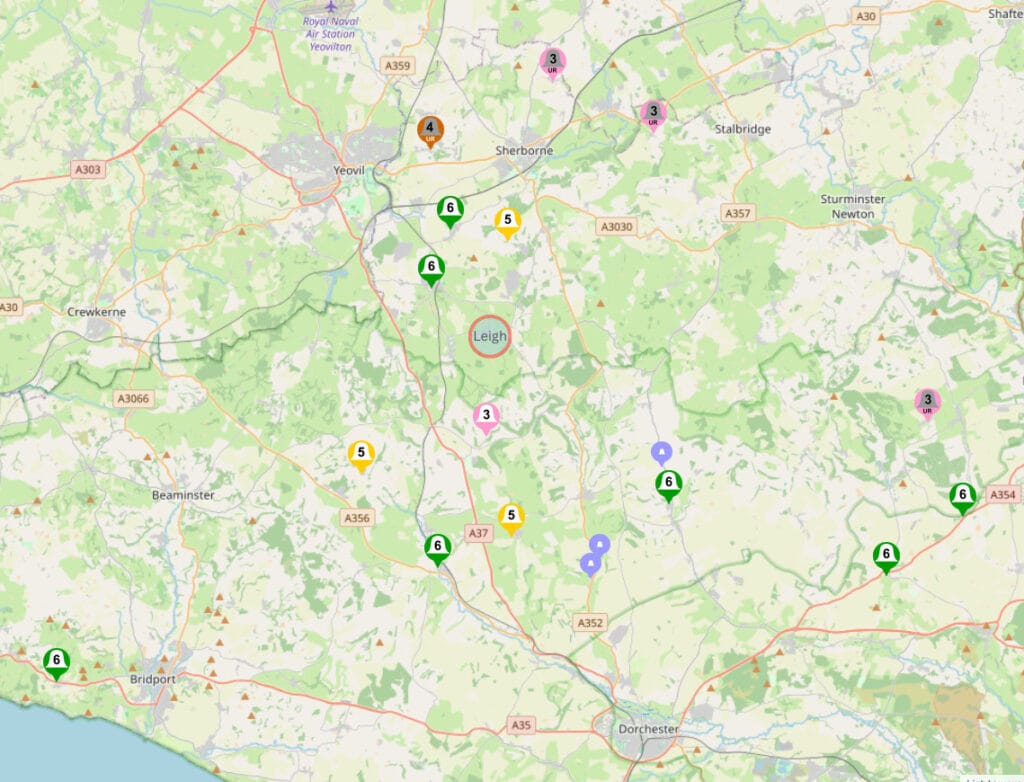
All details and map courtesy of Dove’s Guide
Will, written on 30th August 1620, clearly stating he was a bell founder of Leigh (Ligh)