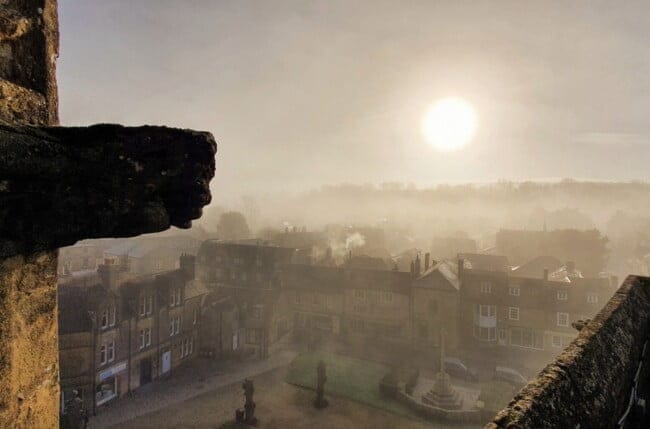
Frampton, a small, but pretty, village sandwiched between the Yeovil and Crewkerne roads, is not a stop on most ringing tours of Dorset. Only the bravest tour bands attempt ringing at Frampton, and even the most experienced bands struggle to produce any rhythmical ringing on the bells. Whilst not for the faint-hearted, the bells at Frampton, and the frame in which they hang, are extremely interesting from a historical point of view. Read on to find out more about the bells, their history, and the project to restore them.
History
Frampton does not appear in the Domesday Book, but a church and small monastery within the village is mentioned as being under the control of Caen Abbey in c. 1204. We know from the 1552 Church Goods Inventory that the tower, which was located at the eastern end of the south nave aisle, contained a ring of five bells, and two smaller bells “abrode in the church”. The position of the tower is uncommon, the only church in the area with a similar design is that at Canford Magna, where the tower is on the eastern end of the north nave aisle. The tower at Frampton collapsed towards the end of the 17th century, damaging parts of the church as well. We do not know any details of the bells within Frampton’s medieval tower, presumably because the bells were damaged beyond repair or destroyed by its collapse.
Frampton’s monastic cell had long since disappeared by this time, but the land had come into the ownership of Robert Browne, who would later build a mansion on it, called Frampton Court. Browne was clearly a man of considerable wealth, for he financed the building not only of a new western tower for the church, but also a replacement set of bells, and the frame they were to be hung in. A plaque above a now-blocked doorway on the south face of the tower records his gift; the tower was completed in 1694.
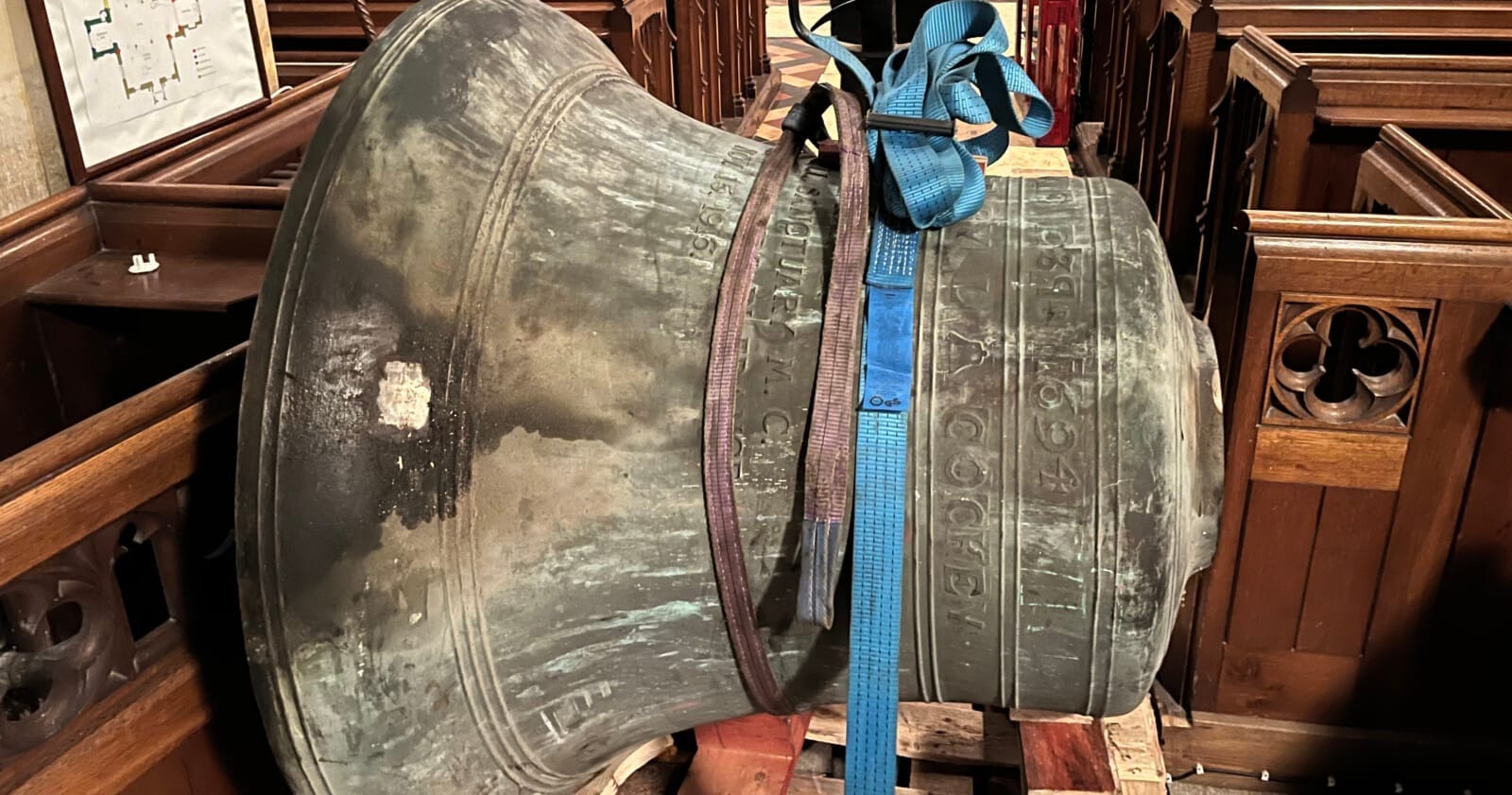
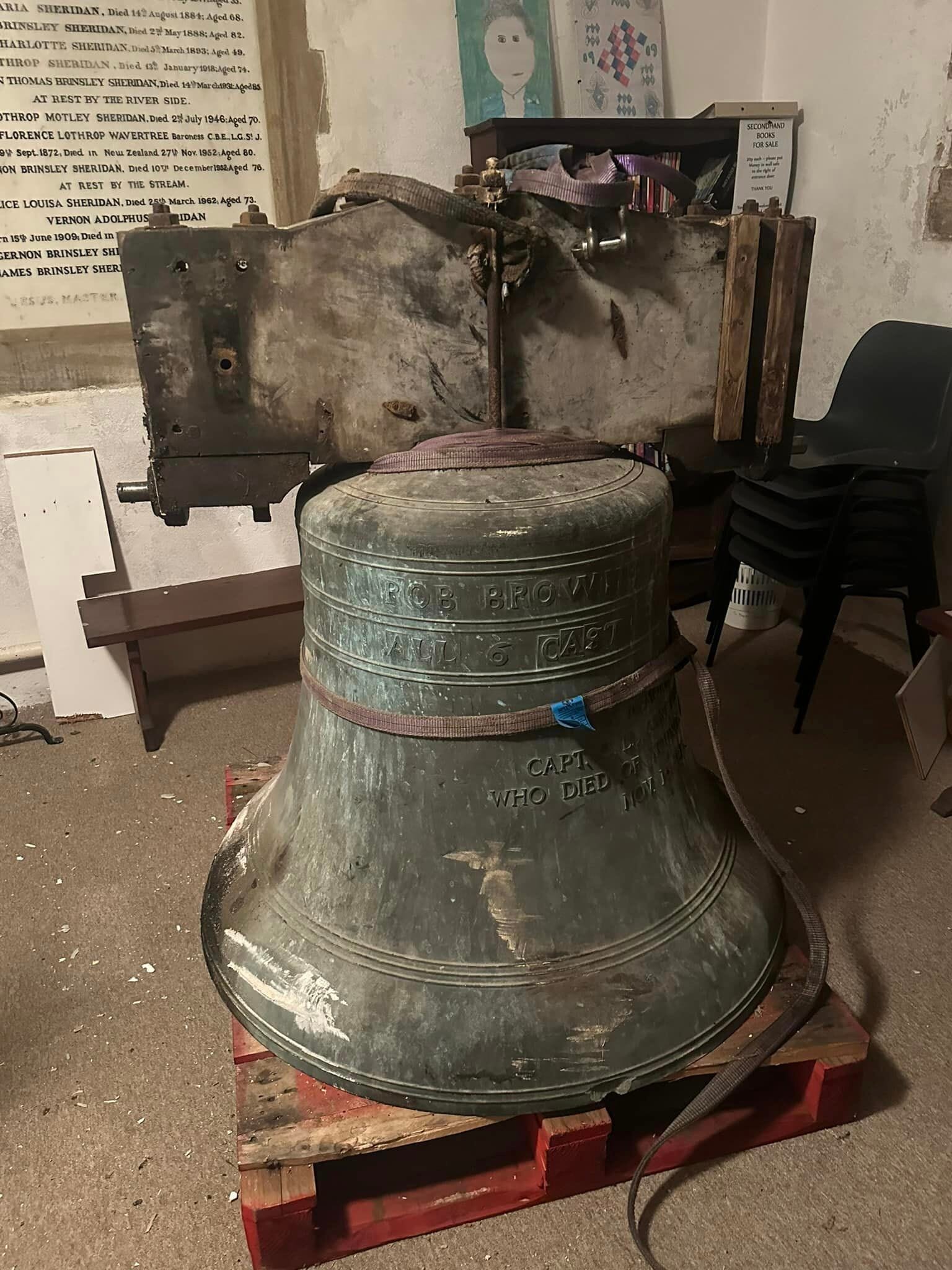
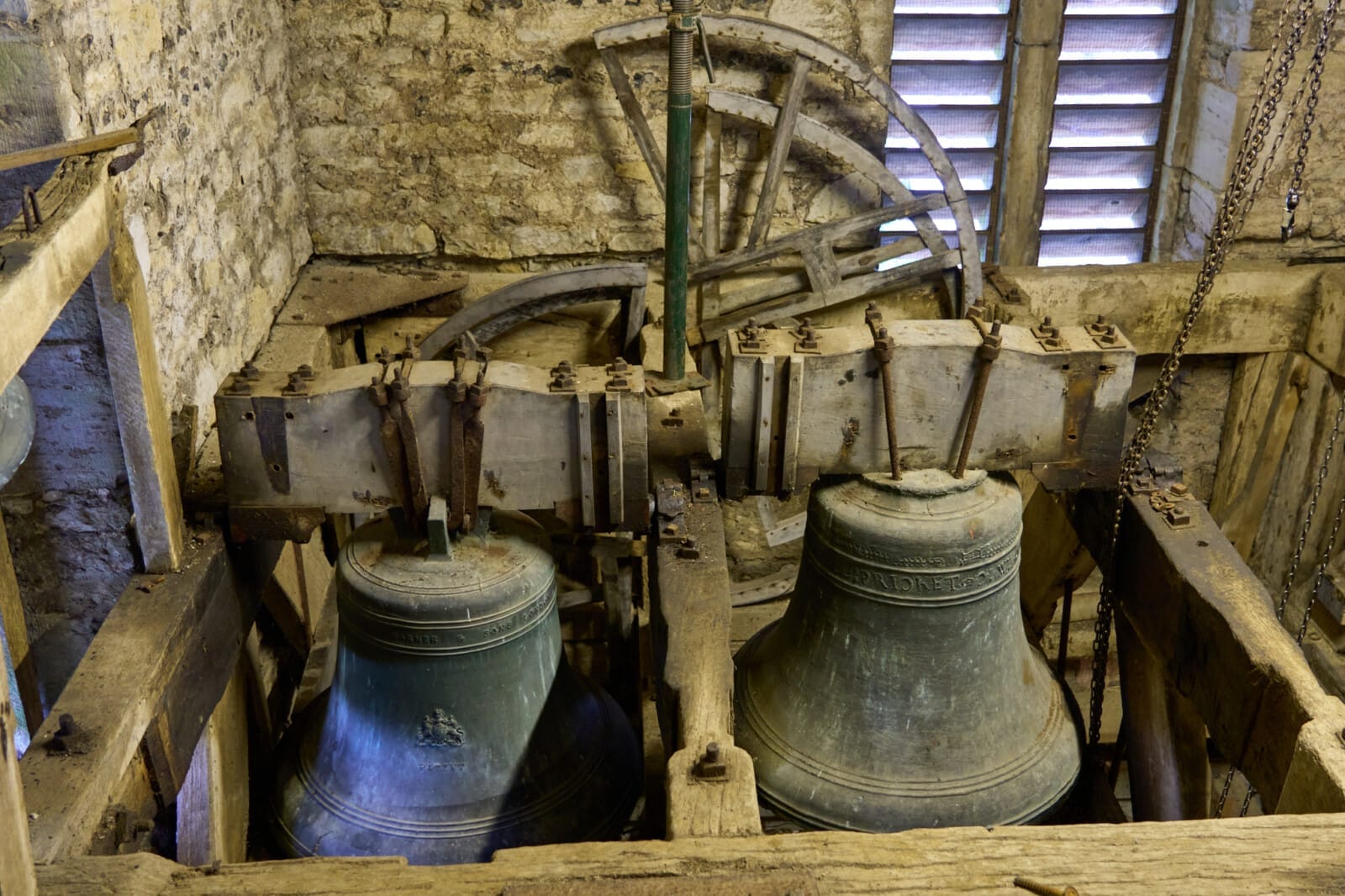
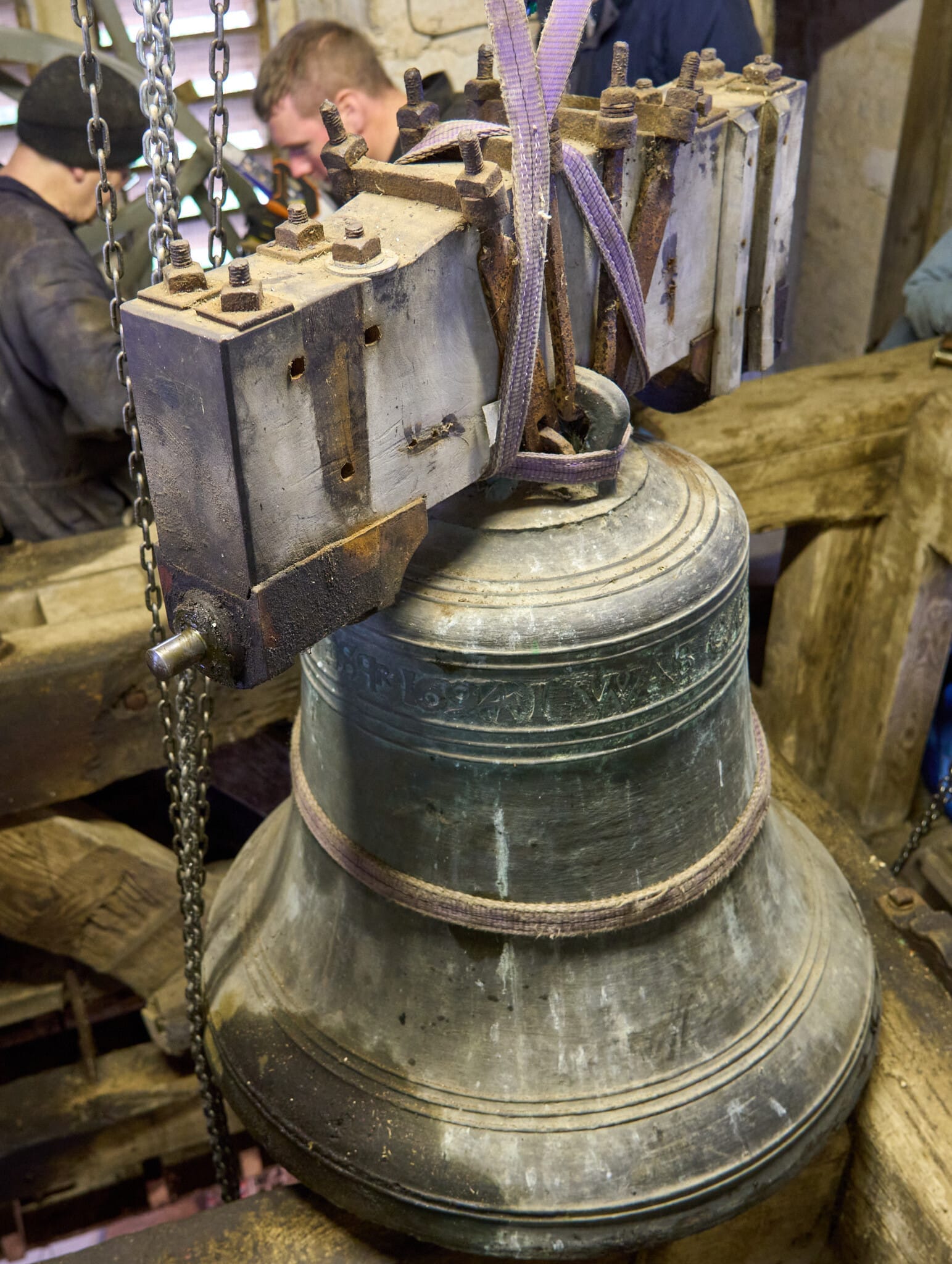
To furnish his new tower, Browne paid Frome founder Lewis Cockey to provide a set of six bells, plus a sanctus bell, and each bell was inscribed with Browne’s name. The bells were hung in a massive oak frame of unusual layout, with four bells swinging north-south and two bells at right angles to one side. We do not know who the maker of the frame was, it may have been a local carpenter, and it is possible the timbers for the trusses came from trees on Browne’s land. The frame is of unusually massive construction, with oak timbers some 12 inches high and 9 inches wide: the trees used to provide this would have had to have been ancient.
The history of the bells from their installation to the middle of the 19th century is sketchy at best. We know from the inscriptions on the present bells that the first bell to be recast was the fifth, in 1733, by William Knight of Closworth. In a strange twist of fate, Knight’s last complete ring of bells, produced in 1739, was for none other than Canford Magna. The bell was cast with canons, though they have since been removed. Unlike the other bells in the tower, the fifth is maiden, meaning it has never received any tuning, either from its founder or since.** Christopher Dalton describes the sound this bell makes as “melancholy”, which is rather more sympathetic than his opinion of the third, which he describes as “potty”.
The treble and fourth were next to be recast, as the inscription on the treble notes, this was down to the Cockey bells cracking. There are indications that the present treble, a typical, thick Warner casting with sharp harmonics, was not intended for Frampton, due to its larger diameter and heavier weight, than the second. Either way, both of these bells were cast, or recast, at Warner’s Cripplegate foundry in 1866. The fourth has Victoria’s coat of arms inscribed upon it. Both bells were provided with new fittings at this point, including plate gudgeons, wooden-topped clappers, and timber headstocks.
The final major work to the bells came in 1920-1921. The tenor bell had cracked in 1916, though even as early as 1870, with Raven’s inspection, he notes it was of “poor tone, much chiselled on one side”. The old tenor, 43 inches wide and 32 inches high, was recast at Loughborough in 1920, coming out bigger at 16cwt and 14lbs, in the key of E, 45.5 inches wide; the smaller sibling of the tenor at Kingston, Purbeck, which was also recast by Taylor’s in 1920. The result is Frampton has unquestionably the finest sounding tenor bell of any ring of six in Dorset; it is, as with all bells produced at Loughborough in that period, a beautiful casting, with true harmonic tuning. The bell was recast in memory of the then rector’s son, who lost his life in France on 15th November 1916 in the Battle of the Ancre.
All six bells were rehung as part of this work, though this was not contracted to Taylor’s, but to Taunton firm Thomas Doble & Son. Doble fitted all six bells with new timber headstocks, plate gudgeons, plain bearings, ash wheels, and traditional stays and sliders. Taylor’s were subcontracted to provide the roller boxes for the bells, and the tenor clapper. Additionally, all of the bells were moved in the frame one place anti-clockwise. The tenor pit became home of the treble, which was reduced in width from 45 inches to 34.5 inches by insertion of a new oak truss; the new tenor was barely large enough to fit into the former fifth pit, and the trusses for this had to be deeply carved out to allow it to swing; similar treatment in a less extreme manner was applied to the fourth, third, and second pits.
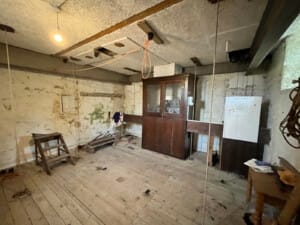
At this time, the bells were rung from the clock chamber, less than 8 feet underneath the bells; ringing would have been extremely loud. This remained this way until the early 1970s, when following the first peal on the bells (5040 Minor (3m), on 21 March 1970), the ringing room was moved down to the ground floor. Only a few years later, the ringing was moved to a newly constructed gallery, located behind the west window. Tim Collins of Bradford Peverell is possibly the only person to have rung a peal on all three levels of the tower, having rung in the 1970 peal and two subsequent peals.
Save Frampton Bells
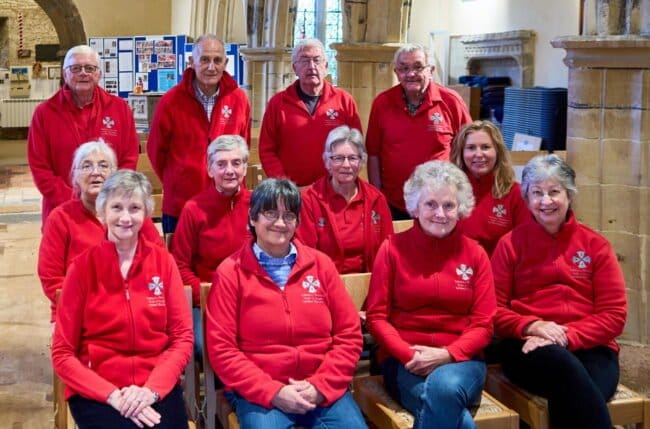
Barring minor work by Arthur Fidler of Bow, Devon, in the late 1960s and early 1970s, the bells remained until October 2024 on their 1921 Doble fittings; the treble retained its 1866 Warner clapper and it is possible more of Warner’s fittings were reused in the 1920s. Going into the 2020s, Frampton had not been regularly rung in four decades, and their condition deteriorated as a result. It was not until lapsed ringer Gareth Down moved into the village at this time that things began to look up. Gareth and I worked together to form a plan, have firms inspect the bells, and start up a new band to keep them ringing. The bells were inspected by Taylor’s and Whites’ over the winter of 2022-2023, whilst Gareth, with the help of Jane Pridmore and Sylvia Fowler, helped train a new band on the considerably easier bells of Maiden Newton.
With fittings over one hundred years old and lack of regular maintenance or ringing, the bells were extremely hard initially to ring, especially the tenor. With some minor maintenance by Taylor’s and more regular ringing by the new band for special occasions, the bells did improve, however, it was clear that unless something was done soon, they would soon be unringable – all the headstocks showed evidence of attack by woodworm, the grease seals on the gudgeons had collapsed on some bells, and the bearings long past their best, together with fractured wheel rims, and clappers well beyond the point at which they could be serviced.
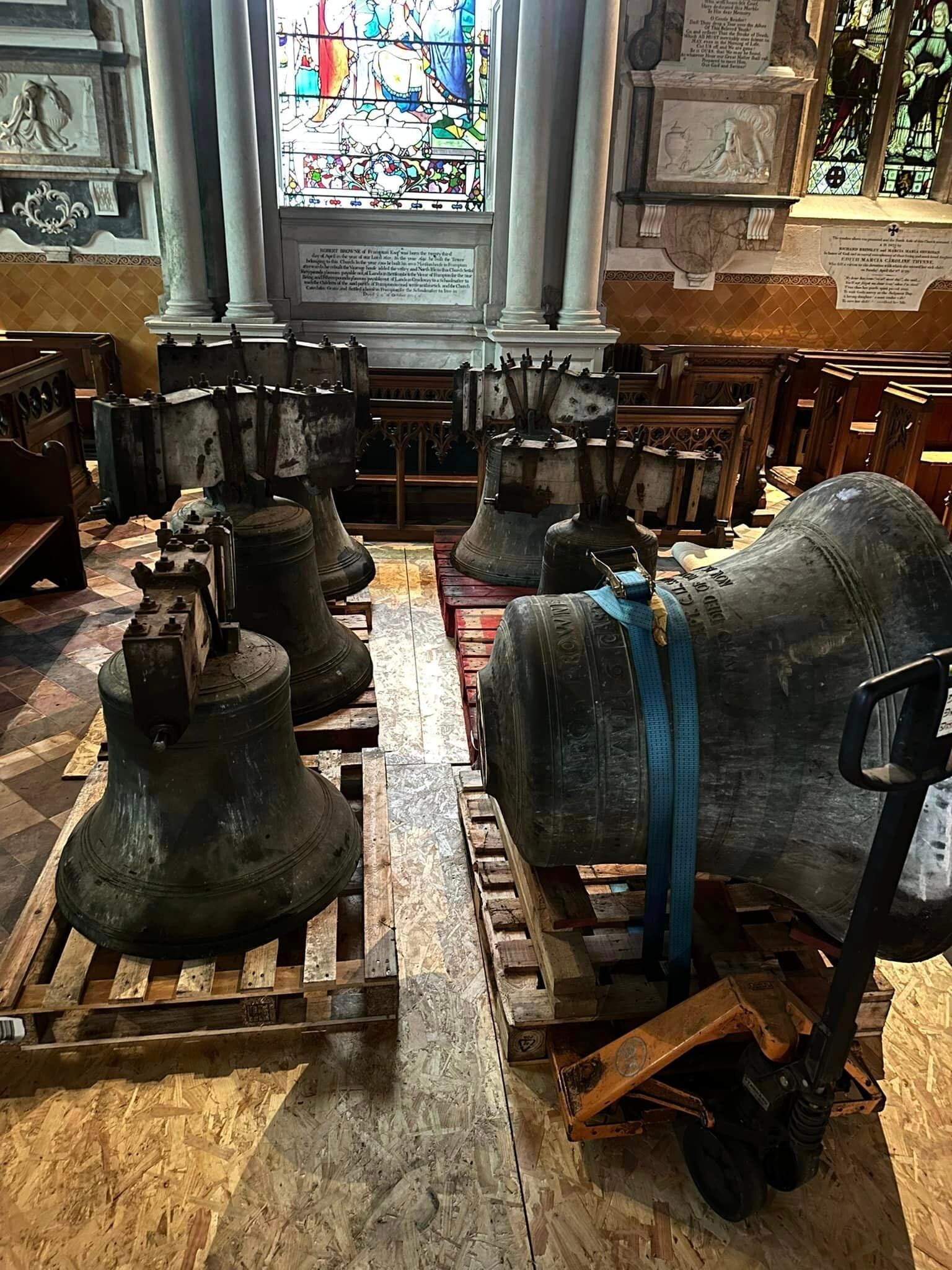
Gareth and I agreed that if I tackled the faculty side of things, we’d both work together on the grant applications and he’d take the lead on the physical elements. After several months of preparation, the faculty was granted by the Chancellor on 16th October 2023, and enough money had been raised or promised by October 2024 to enable the removal of the bells. Following the final quarter peal on the bells by a West Dorset band on Sunday 20th October, dismantling began on the 21st. The fittings were removed first, including stays, sliders, wheels, and clappers; followed by the opening of the trapdoors. The tenor was lowered to the floor with considerable effort on the Monday too; the fact it had been hung in the fifth pit meant it was a challenge to remove it from the belfry; it was really too large!
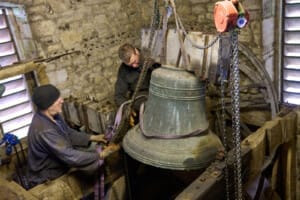
On Tuesday, a full team of helpers including Gareth and me, Simon Adams from Taylor’s, Tim Collins, local ringers Catorina and Ian, plus a visiting duo from Bere Regis, helped remove the remaining five bells from the tower. Following a 90-minute slog inserting a new RSJ into the roof so that a hoist could be attached to it, the third was lowered just after midday, followed by the second after lunch. The fifth proved a major headache, for it had to be lifted up clear of its pit, and transferred across to the tenor pit to go down, but owing to the low height of the RSJs, the bell could not be lifted high enough to clear the frame bolts: much tugging, grunting and shouting whilst manpower was used to gently and slowly manipulate it around the frame. This was followed by the fourth, and then treble, around 7 pm.
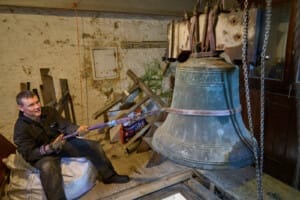
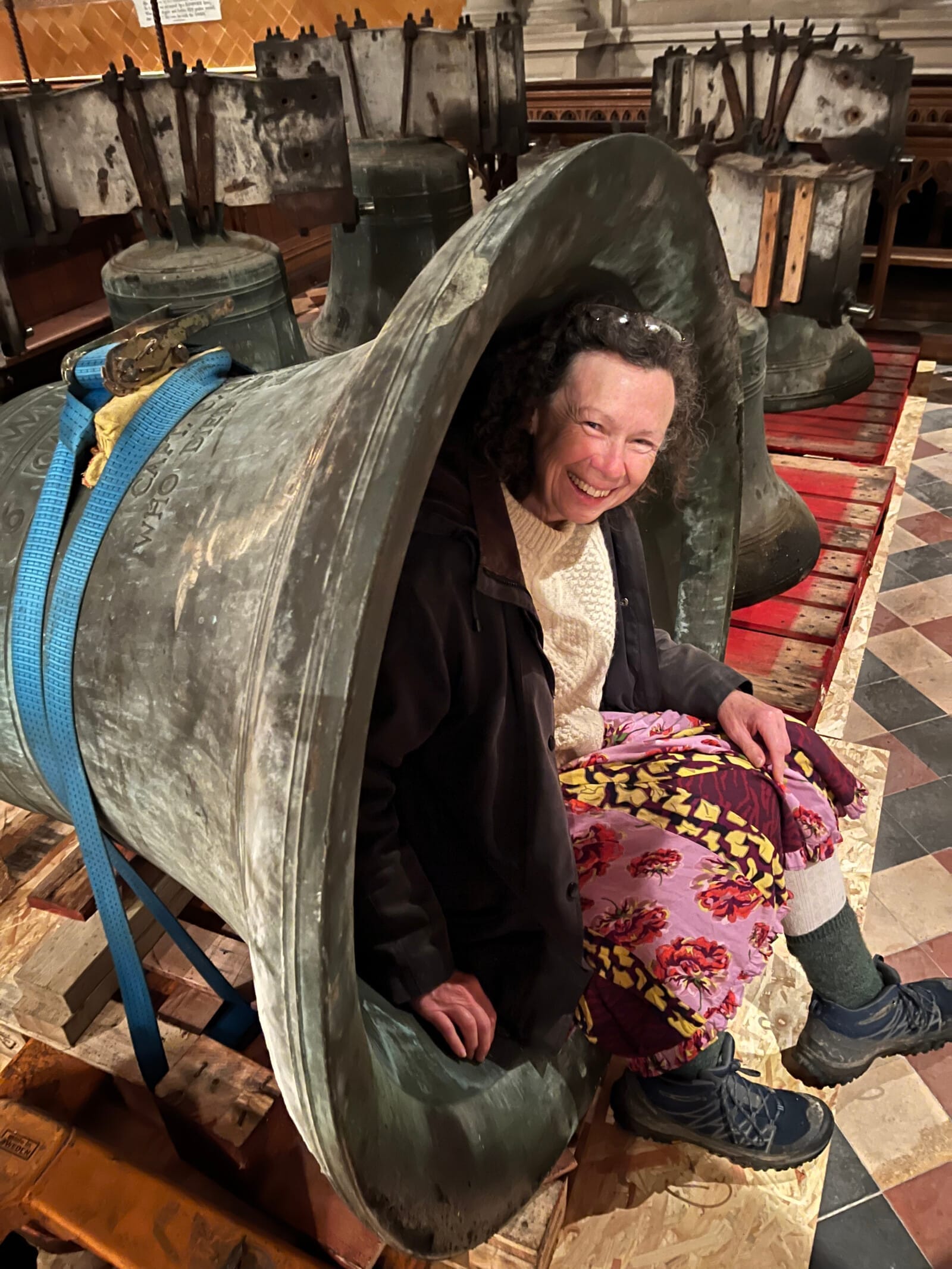
A further problem occurred when the tenor, 45.5 inches wide, would not fit through the gate at the base of the tower, which is only 38 inches wide! After some head-scratching, the headstock was removed (and was revealed to be mostly rotten inside!), and the bell was turned on its side, as it turned out to be 37 inches tall.
The bells left Frampton, for the second and third, the first time since 1694, on Friday, and arrived at Loughborough for complete restoration on Monday 28th October. So thus ends the first chapter in a once-in-a-lifetime restoration of Frampton’s bells, two of which are amongst the rarest in England.
** -The fifth will be tuned on the lathe at Taylor’s shortly after this article is published.