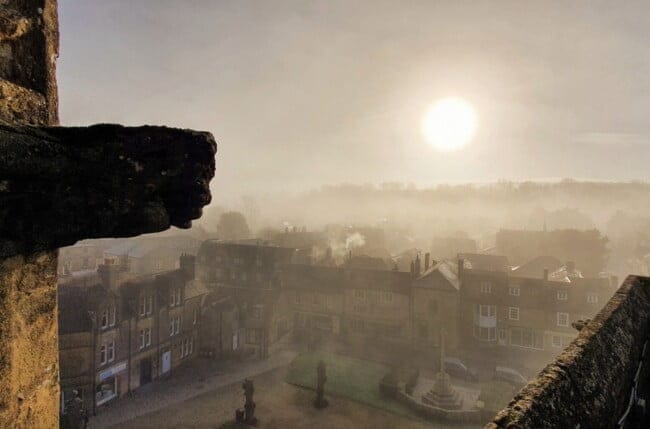
The present tower was built between 1400 and 1404 as what would become the first stage in a near-complete rebuilding of the church. Constructed of four stages, each one roughly equal in height, the tower remains unfinished to this day.
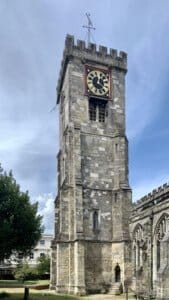
Photo: Jack Pease
Originally constructed as a detached tower, separate from the walls of the church, the lack of buttressing caused the newly built tower to lean, and the beginning of a spire (most likely inspired by the cathedral’s new spire, completed in 1320) was abandoned.
Between 1470 and 1490, the nave was rebuilt and expanded in footprint, so that the north wall of the tower became part of the south wall of the nave aisles, and since then it has remained joined to the building on the south side.
There are several references to bells and ringers in the tower in the 15th and 16th centuries, but one of the few that can be regarded with any certainty is the installation of ‘jacks’ on the eastern face of the tower in 1581. Similar to the famous ‘Quarter Jack’ figure on the tower at Wimborne Minster, he is a regimental soldier with an axe that strikes two small bells (approximately 1-2cwt each) to mark the quarter hours in the ‘ting-tang’ fashion. Like the original jack himself, these two bells date from 1581 and were cast by John Wallis of Salisbury.
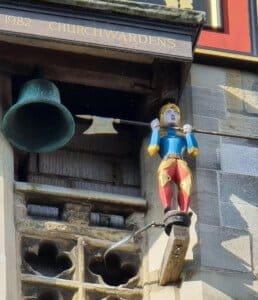
Photo: Richard Avery
Not including the quarter jack and his bells, the churchwarden’s accounts from 1547-1717 still survive and paint a good picture of the situation with the bells. In 1630, following a meeting of 10th November, John Dawton of Salisbury was instructed to cast a fourth bell for the tower, which implies the tower had three bells by this time.
The accounts record he is to be paid 14s per cwt for this new bell, though it does not record how much this new bell weighs. However, on the basis that in 1631 he was also asked to cast a new fifth bell, again at 14s per cwt, and that this new bell is recorded to weigh 19-1-12, it is likely that the fourth bell weighed approximately 14 cwt.
In 1661, William Purdue III was contracted to recast all the bells and add a sixth, “to within a quarter of a note to the bells at St Edmund’s”. St Edmund’s tower had collapsed in 1656 and the resulting new ring by Purdue had given so much satisfaction, that St Thomas wanted a replica!
Purdue also recast the sixth of the ring of eight the cathedral had that year, and this bell still survives today as the cathedral’s hour bell. The churchwardens accounts record the weight of the bells before and after his recasting, showing the total weight of the five bells pre-1661 as 89-0-12 and the total weight of the new ring of six as 83-1-5.
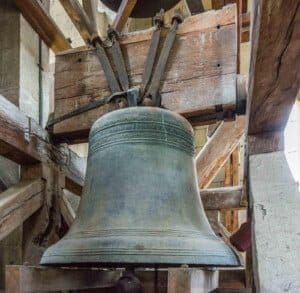
Photo: Jack Pease
The fifth of the ring of six at St Thomas was recast again in 1683 thanks to the gift of John Wyndham, presumably after cracking. The bells were augmented to eight by the end of the 17th century, but the accounts are not clear about when this took place, or who did the work. In 1716, Abraham Rudhall of Gloucester was contracted to recast the ‘great bell’, which following the recasting, weighed 28cwt, as well as the second bell of the eight, both of which had cracked.
In 1771, Robert Wells of Aldbourne recast the remaining seven bells, to form the present ring of eight, although they no doubt sounded very different then, compared to now. There is a local legend that these seven bells were cast from the metal of the former ring of eight from the cathedral, but this cannot be true because the bells were not removed from the cathedral tower until 1777, some six years after these bells were recast!
The next major work to the bells was by Gillett & Johnston of Croydon in 1948. The bells, fittings and frame were removed to the foundry in Croydon, where they were rehung in a newly-built cast iron and steel two-tier frame, with the treble, second, and fifth on the upper tier. The bells were not tuned or modified in any way, except for quarter-turning them on their new headstocks, to provide wear on a new point on the soundbow. The canons were retained on all eight bells, and the bells were not tuned. The bells were reweighed just before they left the foundry, where the tenor was revealed to be 27-1-20.
The new frame was, and still is, of sound design, but the retention of the canons meant cumbersome and poorly executed canon-retaining headstocks were required. The design of these headstocks was unsatisfactory and was responsible for many of the difficulties in ringing the bells accurately. By 1999, the go of the bells was poor, several clappers continuously came loose despite regular tightening, and owing to the fact the bells had never been tuned as a complete ring, the bells were not well in tune.
The ringers set out to rehang and retune the bells to solve these problems and permission for the project was granted by the PCC in January 2003. English Heritage and the Church Buildings Council wished to preserve the canons on the bells owing to their age but the ringers argued the aims of the project were not possible with their retention. A compromise was agreed, whereby the canons would be removed from the back four and retained on the front four. The removal of the bells by Whites of Appleton began on 1st October 2003 and they were returned to the church, following all new fittings and retuning at Whitechapel, on 18th March, with the try-out achieved on 2nd April.
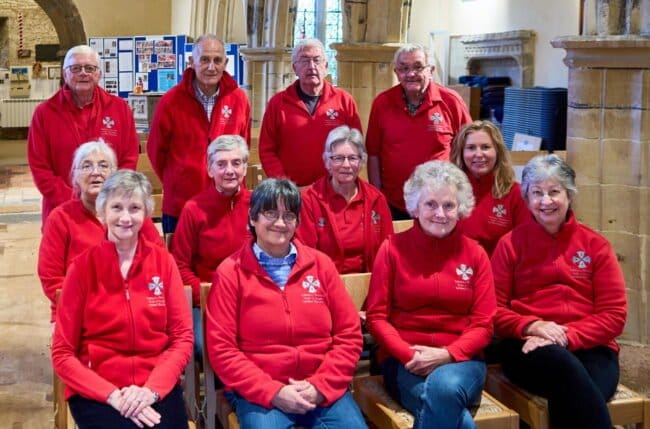
The result is a fine-sounding heavy ring of eight in the key of D-flat, with a tenor of 25-0-18. When the bells are rung well, they are a rewarding sounding ring, but owing to a tall, thin, tower that moves, a long and unguided draught, and that some of the bells are hung on the upper tier, they will never be as easy as other rings of a similar weight. Nevertheless, the project to restore the bells was a success, as the bells are much more evenly struck and smoother to ring, and the sound is much richer. The bells are rung regularly for both practices and service ringing, and the local band welcomes visiting ringers – contact via their tower page here.
Jack Pease