For this month’s tower in focus, we visit Beaminster, in the northwest corner of Dorset. This is a land of steep hills, chocolate-box villages, and unspoilt medieval churches. Beaminster, situated in a bowl-shaped valley, has existed since at least the 7th century, when it was known as Bebingmynster, meaning the church of Bebbe. The mynster-suffix likely refers to a Saxon teaching church, as with Wimborne Minster, Sturminster, and Warminster. No trace of this church is visible, but the present church, dedicated to St Mary of the Annunciation, is a well-known local landmark.
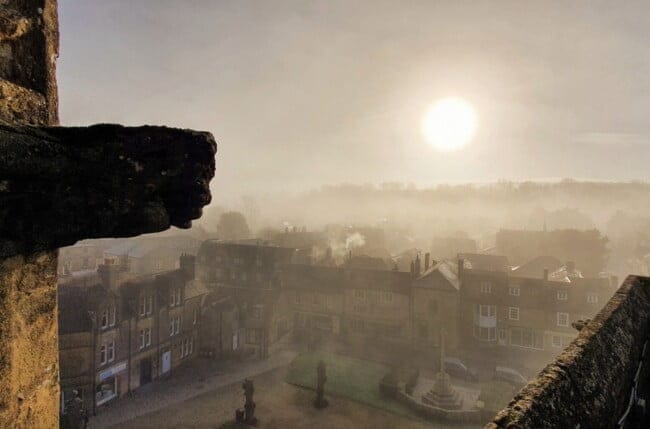
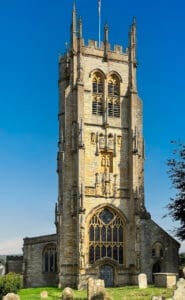
Situated to the south of the town centre at the bottom of a short hill, the first thing one notices is its size, especially that of the tower. Beaminster is home to possibly Dorset’s finest and most ambitious medieval church tower, soaring to 100 feet (30 metres) in height and crowned with no less than 41 crocketed pinnacles; the tower is more akin to those of neighbouring Somerset than those of Dorset. Constructed from 1503 and finished by the middle of the century, its considerable size may be explained by Beaminster’s position in medieval times as the manufacturer of linen and wool. Other churches with famously large towers, including those of Somerset and Lincolnshire, were also financed by the wool trade, as towns competed to outdo each other with the height of their towers. Whatever their intentions, Beaminster has one of the largest and most ornate towers in the county, rivalled only by the medieval constructions at Wimborne, Sherborne, and Christchurch, the latter of which was of course in Hampshire until 1974.
The tower also has a gruesome twist in the tale of its history – in 1685, equipment was set up on the tower roof for the hanging of criminals! Indeed, in that very year, King James II hung several men from the battlements of the tower to demonstrate not only the power of the crown but also as a warning to the people of the town, showing them what would happen if they dared to defy the king.
Early Bells
The tower must have been completed by 1552 because the Church Goods Survey finds just the one bell within it. For a town, this is an uncommonly low number of bells, for others in Dorset such as Wimborne had five bells during the medieval period. Whatever the reason is for only a single bell, within a hundred years Beaminster had caught up, for five bells plus a clock and chimes are recorded in 1651. The church accounts only survive from 1646 onwards, and they make no record of any castings in the first five years of entries, so we are unlikely to ever know who the founders were. We do know from the accounts that in 1755-1756, four new headstocks and new wheels for all five bells were made by a local carpenter and that he made repairs to the ‘bell-cage’.
In 1757, the tenor bell appears to have cracked or been broken, as the churchwardens received £18 1s 6d for nearly four hundredweight of ‘old bell mettle’. Richard Rock, an enigmatic local bellfounder who we only know scant details about, was contracted to recast it. He was based in Beaminster as a ratepayer and had the title esquire, but other than that, we know very little. The vestry minutes confirm he was contracted to recast it, which by all accounts weighed around 30 hundredweight. His efforts fell short of expectations, and the vestry minutes make for interesting reading:
“It is the opinion of this vestry that the great bell cast by Richard Rock is not compleat by reason of some defect in the Cannons, therefore we are not willing it should be hung up with bolts.“
– Beaminster Vestry Minutes, 14th December 1760
They later mention that either Rock should recast the bell at his expense, or pay the churchwardens compensation for his defective casting. Unhelpfully, the minutes and the accounts for the next few years are ambiguous as to what happened with it. They do not record a recasting, but neither do they record Rock paying them compensation. The only clue as to that it was hung in the tower eventually, are the instructions given by the churchwardens in 1764 that the new ring of eight they were seeking be of equal weight to the five bells currently in the tower.
The Ring of Eight
The new ring of eight were cast in 1764-1765 from the metal of the ring of five, by the Chew Stoke foundry near Bristol, owned and operated by the Bilbie family. However, the impracticalities involved in transporting five large bells 50 miles to the north and then bringing eight of them back, meant that the casting actually happened in a temporary location in the town centre! This was not uncommon, many bellfounders set up temporary foundries near the churches they had to cast bells for and move once they had completed their work; sometimes these were in the churchyards themselves.
The founders were Thomas Bilbie I, his son, Thomas Bilbie II, and at least one of the latter’s brothers, most likely Abraham. As previously stated, the founders were told to make the ring of eight equal in weight to that of the original peal of five, for which they were paid £136 8s, according to the accounts. Whilst this may not seem much money, the Bank of England’s inflation calculator helpfully reveals that today, that money would be worth over £20,000. Of course, it would not be possible today to cast a new ring of eight of any substantial weight for this sum of money, but does prove to show that even in those days, the church coffers had plenty of money!
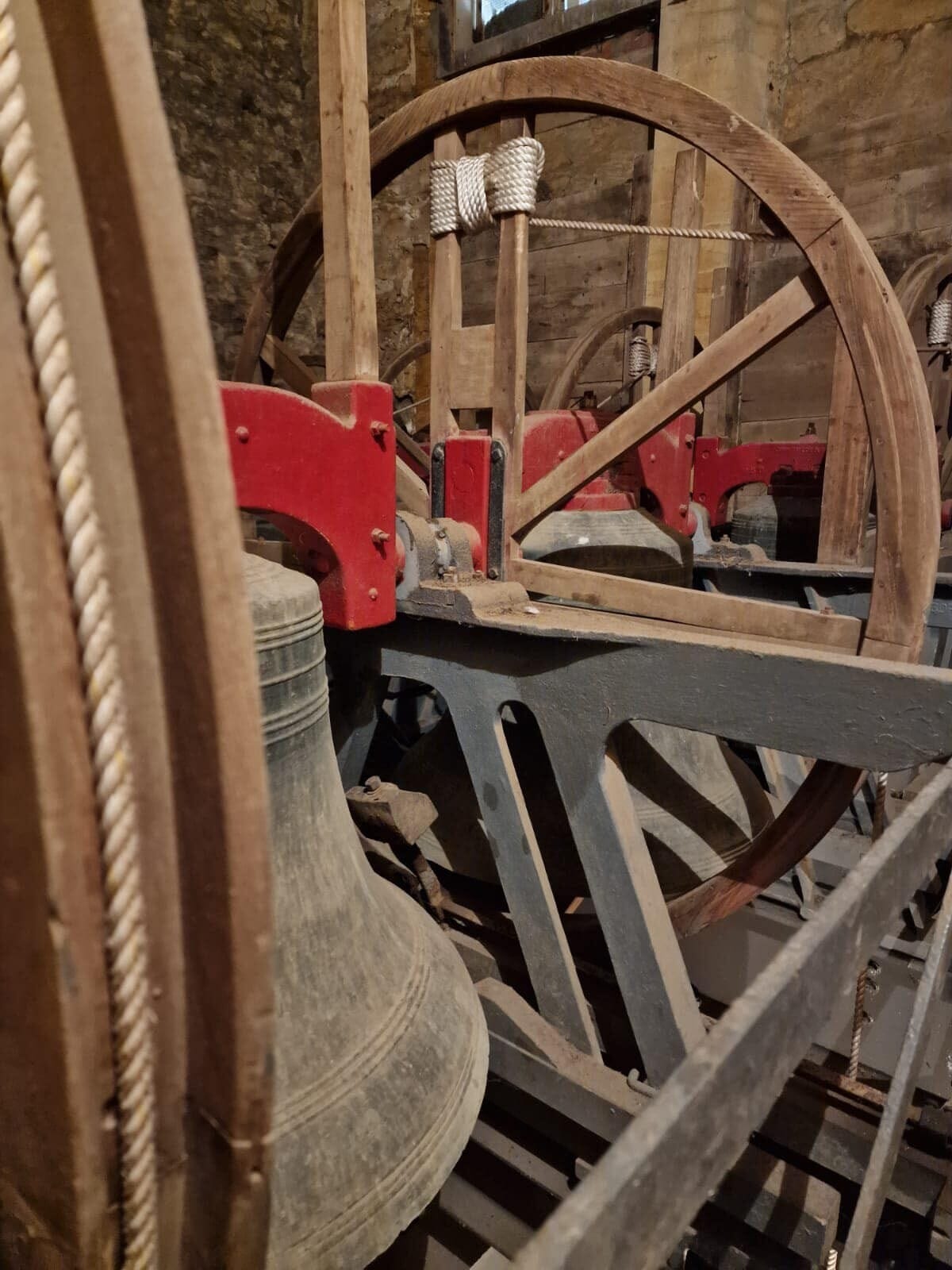
The bells were hung near the top of the tower in 1765 in a new oak frame made by Daniel Sykes, with all new fittings by the Bilbie foundry. Some of these fittings lasted over one hundred years, though how frequently the bells were rung full circle in the early years is dubious, they may just have been swing chimed.
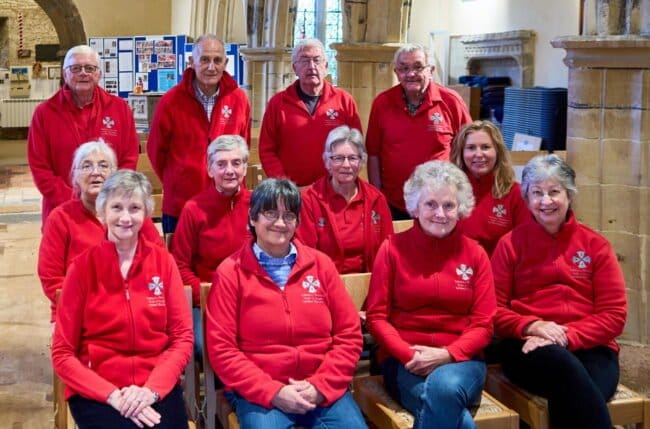
The Beaminster Guild of Ringers
In 1874, a guild or society of ringers was formed at St Mary’s Beaminster, comprised all of men – no women were allowed to ring there in those days! The Guild was formed of eight full members and nine honorary members, who had to pay 1s to be admitted to the society, and 1s 6d each year for their subscription. The ringing guild at Beaminster does not sound like an especially pleasant place in their early years, with regular fines for even the most trivial offences – the church accounts record that these fines were regularly imposed and strictly enforced. These included, but were not limited to, any full member missing service ringing being fined 6d, and for leaving the tower before ringing had finished, or before the tower captain granted permission to leave, 2s 6d! At the AGM every January, the previous years’ subscriptions and fines would be added up, and split unevenly amongst the members: honorary members were collectively given one-ninth of the total, with the full members receiving the rest, less any fines.
The society in its early days likely rang something akin to call changes, possibly from boards in the ringing chamber. In 1888, the society joined the Salisbury Diocesan Guild, but it would not be until 1900 that they would begin to attempt so-called ‘scientific’ ringing. Method ringing books were purchased and a Seage dumbbell apparatus was installed to aid in training. The first real progress seems to have been in 1910, when the headmaster of Bradpole School, Mr. T. Harvey Beams, walked five miles to Beaminster to instruct the Guild in ringing whole-pull Grandsire Doubles. By the end of the First World War, when the Headmaster again visited Beaminster, he was instructing them on Plain Bob, Grandsire, and Stedman Triples.
Recent History
The first peal on the bells and indeed in the town, was rung by the Salisbury Guild on 20 May 1907, being 5,040 changes of Grandsire Triples in 3 hours and 9 minutes. The ringer of the fifth was none other than the Bradpole Headmaster. Several more high-profile peals would be rung on the bells, including the first peal of Bristol Surprise Major in the county, 5,056 changes on 14 September 1912.
Only a few pieces of repair work had been undertaken on the bells up to this point, which was mostly confined to an 1887 restoration by John Taylor & Co., where the wooden headstocks and plate gudgeons were restored or replaced. The clappers were rebushed by Mears & Stainbank in 1924, and in 1938, Taylor’s returned to rehang the bells on ball bearings.
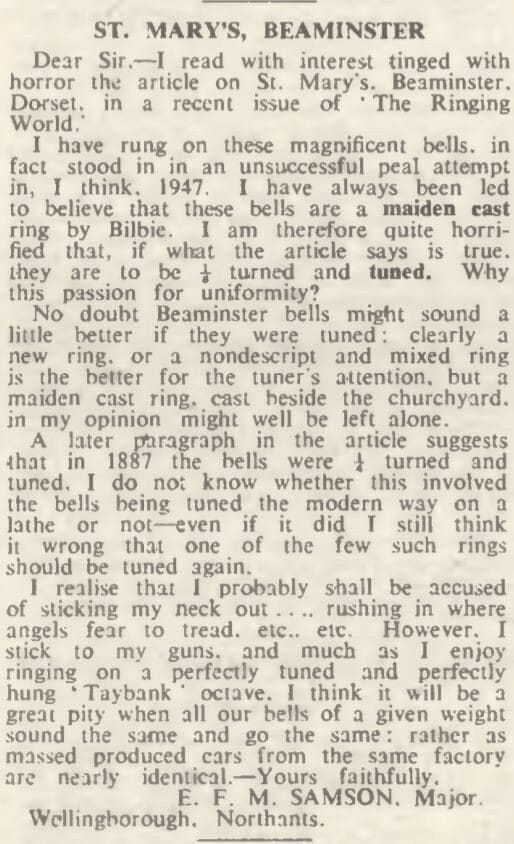
By 1960, an article in The Ringing World lays bare the problems encountered with ringing the bells. The oak frame had been severely weakened by two centuries of wood-boring insect attack and was beginning to rot. A restoration project was launched, with a fundraising target of £4,000. The work would involve, they hoped, rehanging the bells in a new metal frame lower in the tower than the present, replacing all the fittings, and tuning the bells. Not everyone was thrilled with these plans, as only one week later a strongly-worded letter in the Ringing World appeared objecting to the plans to tune them.
Nevertheless, plans proceeded, though progress was very slow. By the time Taylor’s inspected the bells in July 1966, only £91 had been raised in six years. The inspection, carried out by the manager and owner of Taylor’s, Mr Paul Taylor, revealed just how bad things had got. The frame timbers had become so heavily eroded from rot and insect attack, that in places they were barely a few inches thick. Paul Taylor also watched the frame whack the tower walls when the bells were rung and recommended ringing ceased to avoid causing structural damage.
This seems to have given the local band the necessary kick to progress the project, for by the time the bells were removed the next April, £730 had been raised and a further £1,200 promised. The BBC filmed a segment on the removal of the bells, which helped bring further attention to the project. The bells were removed from the tower in early April 1967 to Taylor’s foundry in Loughborough for complete restoration. The eight bells were tuned, the canons removed from the lightest five bells (those of the heaviest three having been removed in 1887), and all new fittings manufactured. That summer, the PCC and ringers asked Taylor’s to amend the order, to rehang them not only in a new metal frame but a frame for ten bells. Whilst they did not have the funds to order the two additional bells at that time, they anticipated it would make future augmentation easier. A further £1,200 had been raised by this time, bringing the total to just under £3,000.
Consequently, in the autumn of 1967, the new ten-bell frame arrived at Beaminster for installation, followed by the bells and their fittings. The dedication service in December, attended by nearly 500 ringers and conducted by the Bishop of Salisbury, was a great success, with Taylor’s congratulated on their work. They are indeed a fine old-style octave, with a tenor of 22 and a half hundredweight, being the oldest complete ring of eight or more bells surviving in Dorset. The augmentation to ten did not take long, the trebles were cast from 1972-1973 at Loughborough, giving Dorset its fourth ring of ten, after Wimborne Minster (1911), Poole (1937), and Wareham, which were also augmented to ten in 1972.
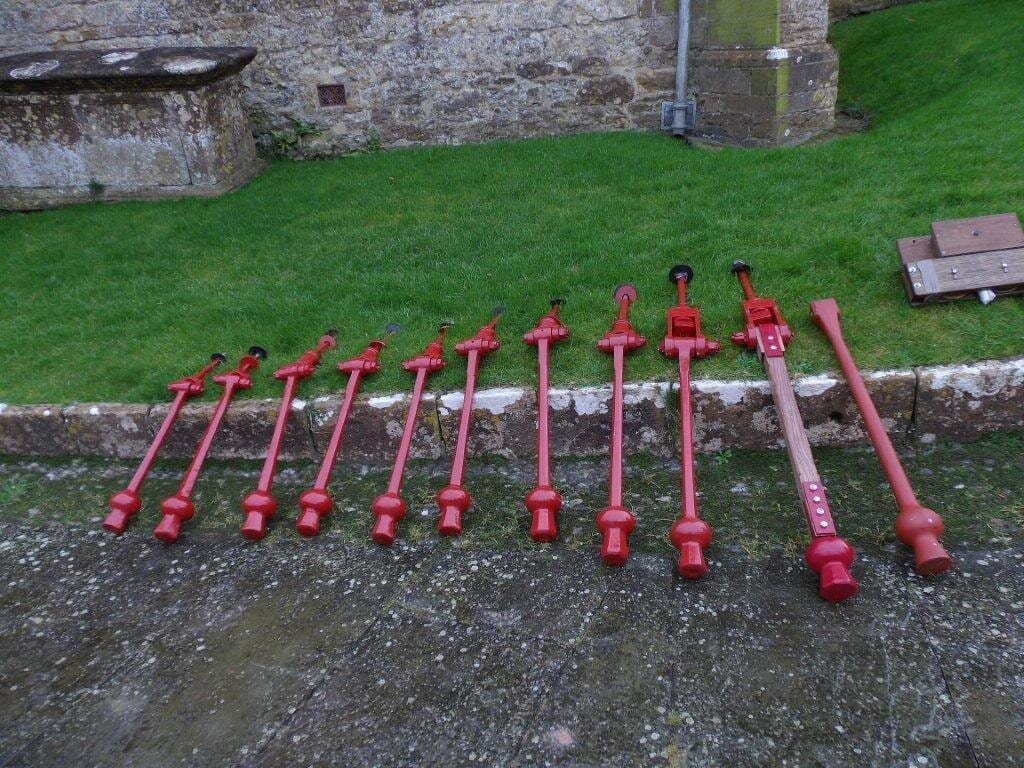
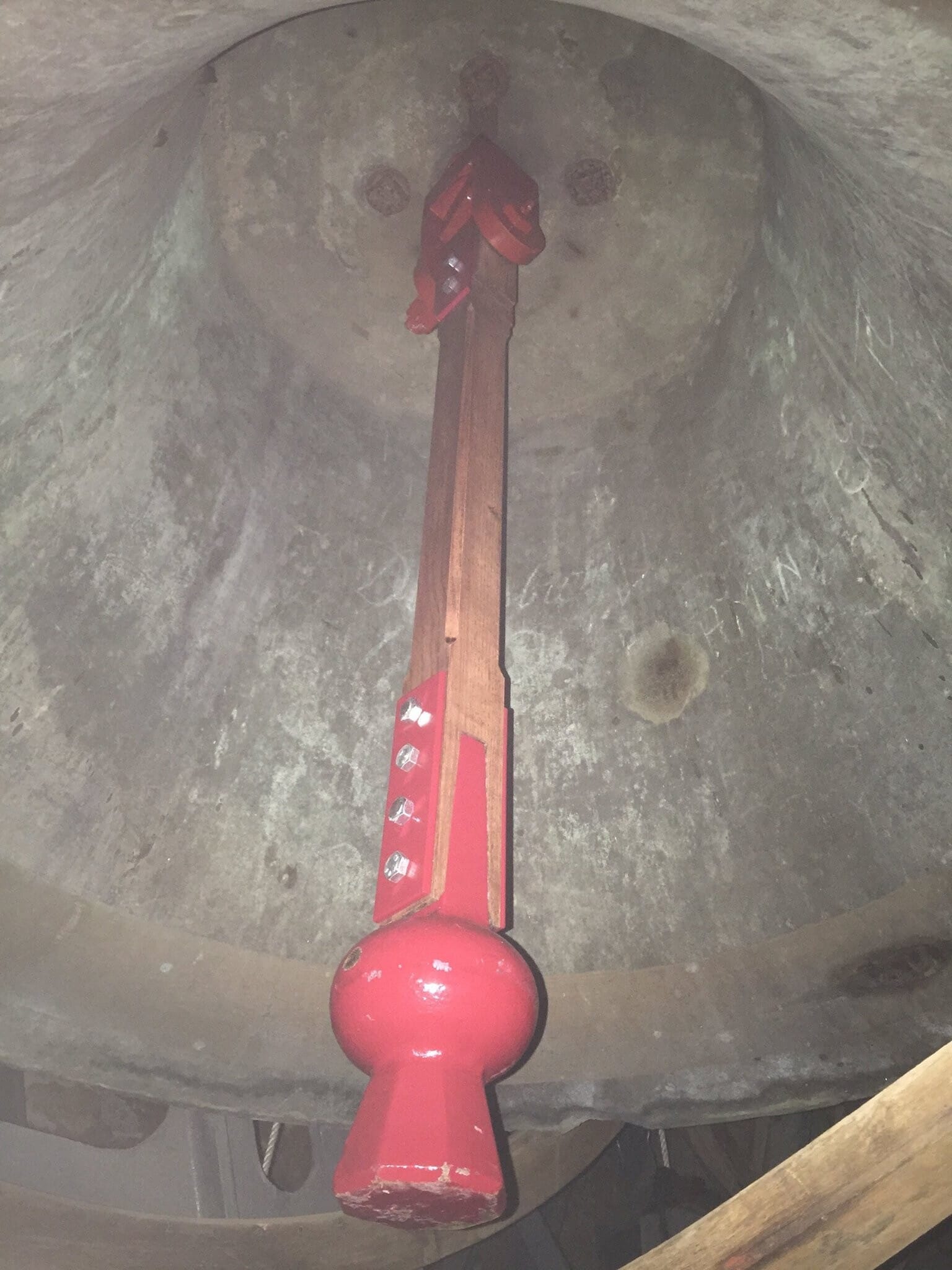
Only minor maintenance work has been carried out on the bells since then, most notably the repainting of the frame and restoration of clappers and crown staples by Taylor’s in 2017, when the tenor clapper was retired and replaced with a wooden shafted version, to aid in ringing the bell ‘up right’ and improving its sound and performance. The bells are kept in good condition and are enjoyable to ring and listen to; a must-visit if one is ever in this part of the county.
The Chimes
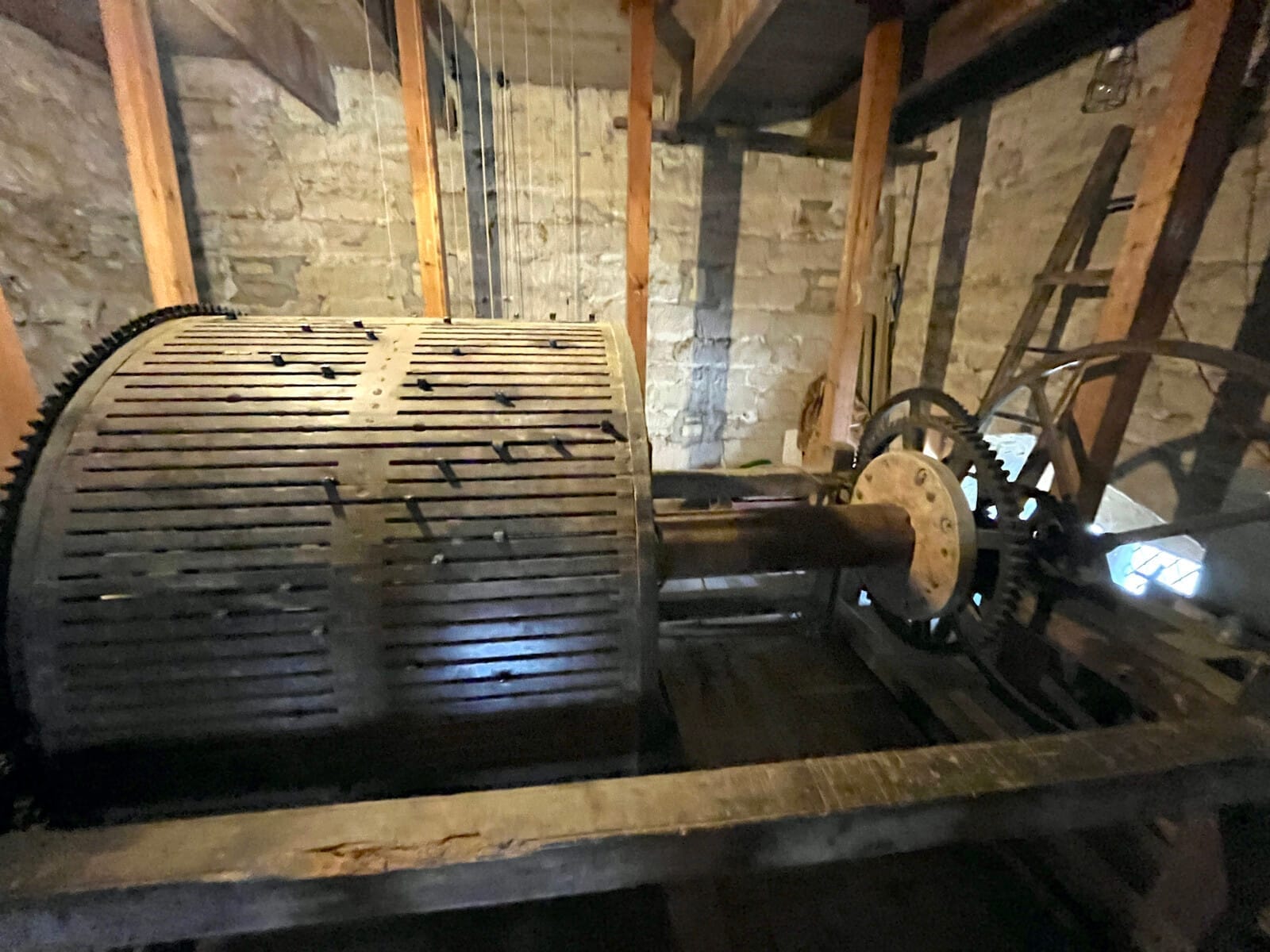
Whilst not something that is seen by most of the ringers at Beaminster, or indeed by visitors, the clock chamber, located between the ringing room and the belfry, contains a fantastic chiming barrel, originally installed in 1767 to play two tunes on the bells through use of hammers. In 1780, this was altered to play one tune – ‘Hannover’ – which it still does every three hours during the day, providing the bells have not been left up. If you visit the ringing chamber at Beaminster, ask to see the chimes!